


Test: The Conway GRV 1200 comes with a high-quality carbon frame and all-round impressive equipment for less than 3.000 euros. In practice, it is agile and lively, and its seating position should appeal to sporty drivers in particular.
1200 Conway GRV2020: The Facts
Frame material: Carbon
Wheel size(s): 700 cc
Maximum tire clearance: 45 mm
Axle dimensions (v/h): 12 × 100/142 × 12
Mudguard Eyelets: Ja
Luggage carrier eyelets (v/h): No
bottle holder: down tube up, seat tube
Weight wheels v/h/total (with tires and brake discs): 1.540g / 1.651g / 3.191g
Weight complete bike without pedals (size M): 8,93kg
Price: 2999 Euro
Sporty frame with crosser genes


It has been almost three years since Conway presented its first gravel bike to the public, the GRV series. The name has remained the same to this day, the bike and the frame have moved with the times, even if the Conway GRV has remained true to its original approach: A sporty gravel bike that should feel just as comfortable in a cross race as on an after-work lap or also the more leisurely tour with the family. It is available with a carbon and aluminum frame and in a total of four equipment variants. The top model GRV 1200 we tested naturally comes with the aforementioned carbon frame and its weight remains well below the 3.000 kg mark despite the relatively low price of just under 9 euros.

The frame is visually appealing at first glance and, in addition to the features that are a matter of course in this price range, such as internally routed cables or thru-axles, it also has clever details: An optional bridge can be mounted on the rear triangle in order to be able to attach mudguards here, which is the area on the seat tube designed in such a way that the GRV can be comfortably shouldered during cross races, for example. Somewhat surprisingly, Conway uses 31,6mm for the seatpost size - the large diameter could be at the expense of comfort. It looks really good for fans of thick tires: the frame and fork offer plenty of space and, in our opinion, even 45mm tires should still have enough space here to be able to turn freely even with a pack of mud. The frame has to be a little weak in terms of mounting options - here you have to be content with two bottle holders and eyelets for mudguards.

In terms of geometry, the crosser in a gravel bike shines through in some details: there is the fairly steep steering angle and also the extremely short chainstays at 420mm. The wheelbase remains compact and the numbers promise agile handling, which should appeal to sporty drivers in particular.
Geometry Conway GRV 1200 2020
| S | M | L | XL | |
| seat tube (in mm) | 470 | 500 | 530 | 555 |
| Top tube horizontal (in mm) | 528 | 545 | 570 | 590 |
| chainstay (in mm) | 420 | 420 | 420 | 420 |
| Wheelbase (in mm) | 998 | 1011 | 1026 | 1046 |
| Steering angle (in °) | 71 | 71.5 | 72 | 72 |
| Seat angle (in °) | 73.5 | 73.5 | 73 | 73 |
| Reach (mm) | 361 | 374 | 388 | 402 |
| Stacks (in mm) | 564 | 576 | 597 | 616 |
Consistently high-quality components with a small flaw
As I said: The Conway GRV 1200 Carbon is the top model of the model series and, for the almost 3.000 euros that it costs at a specialist dealer, comes with a carbon frame and full carbon fork and convincing equipment down to the last detail. When you look at the spec table, you almost have to ask yourself: why spend more?
| Frame | Conway Gravel Carbon |
| Fork | Carbon YOU |
| Wheels | DT Swiss GR1600 |
| Tires | Schwalbe G-one Allround 40mm |
| Derailleur | Shimano RD-RX810 GRX |
| Shifter | Shimano ST-RX810 GRX |
| Crank | Shimano FC-RX810 31/48 GRX |
| Front derailleur | Shimano GRX |
| Brake | Shimano BR-RX810 |
| Seatpost | Conway Patent 31.6mm |
| Saddle | Conway 1489 Sport super light |
| Stem | FSA Energy |
| Handlebar | FSA Adventure Gravel Compact |
The equipment with a complete Shimano GRX 2-speed gravel group including the corresponding brakes is remarkable. Other bikes in this price range also offer this, but the manufacturers usually save on the cranks or the brakes, where the cheaper RX8xx parts are often installed instead of the RX6xx components. The GRV 1200 Carbon is different: Here there is a flawless GRX RX810 group with the double crank and its exciting chain ring combination of 2 and 31 teeth. Together with the 48-11 cassette you get a very good range of 34% and small gear jumps. Ideal for demanding drivers.

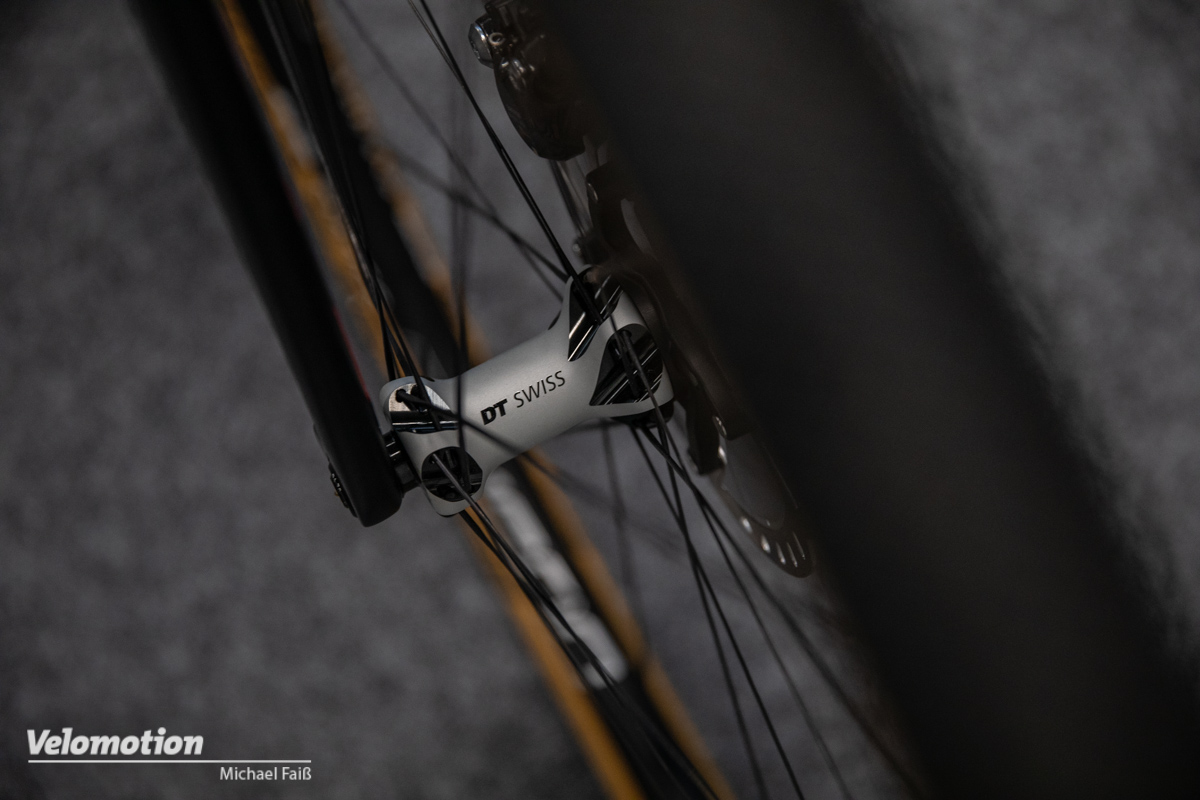

This positive impression continues with the wheels: here you get proven quality from DT Swiss. The GR1600 wheelset is not only light, but also comes with the durable and almost maintenance-free toothed disc freewheel. The cockpit of the Conway comes from FSA and can best be described as unspectacular. The Adventure Compact handlebar has a pleasant and not too extreme flare at 12°. Friends of gravel handlebars can grab the lower handlebars off-road to get more control, but those who prefer to ride classic handlebars shouldn't mind.
The only real criticism of the equipment remains the seat post: The 31,6 mm aluminum post is extremely stiff, hardly flexes and does the comfort of the bike no favors. The good news: if you want, you can easily and inexpensively retrofit a 27,2mm dropper with a suitable adapter.

Let's Gravel
With its revised carbon frame, the Conway GRV 1200 Carbon looks extremely appealing at first glance and is designed to bridge the gap between gravel bike and cyclocross bike.

The GRV 1200 already smacks this crosser DNA with the first pedal revolutions. Not only the geometry ensures a sporty seating position, but also the handling is very direct and agile. Yes, you can definitely venture onto the racetrack with it! But if you use the complete spacers, you can also defuse the position quite well and ensure a somewhat more upright position. The Conway doesn't turn into a thoroughbred tourer - but it doesn't want to be that at all.

The high rigidity of the Conway GRV 1200 is both an advantage and a disadvantage, because this promotes power transmission, but driving comfort suffers somewhat. Unfortunately, the 31,6 mm aluminum post doesn't necessarily help the Conway to take a beating off-road. After all: With an adapter sleeve (note the insertion depth!) you can also easily install a 27,2mm support, which should help here.
We really liked the visual design of the frame - its striking lines and angular shape make it stand out from the crowd. The bike can also be shouldered quite comfortably on the continuous seat stays on the seat tube - interesting for cyclocross fans. Although the internally routed cables are standard, they should be positively emphasized due to their successful introduction into the frame. This also means that no rattling can be heard from the inside of the frame. With further details, such as the removable "Fender Bridge", which simplifies the assembly of the rear fender, but can also be omitted for more tire clearance, one should get more versatility. Unfortunately, the frame does not have any eyelets or mounting points for bags and carriers, which should make a bikepacking adventure more difficult.

With a complete Shimano GRX double group you are well served and should be prepared for every adventure, as both the functionality and the range of the special Gravel group can hardly be surpassed. Another eye-catcher are the high-quality DT Swiss wheels, which should impress on any surface with their robust design and easy running characteristics.
Other gravel bike highlights in the test:
[blog posts_per_page=”3″ taxonomy=”post_tag” tax_term=”42913,42952″ order=”desc” orderby=”rand”]
