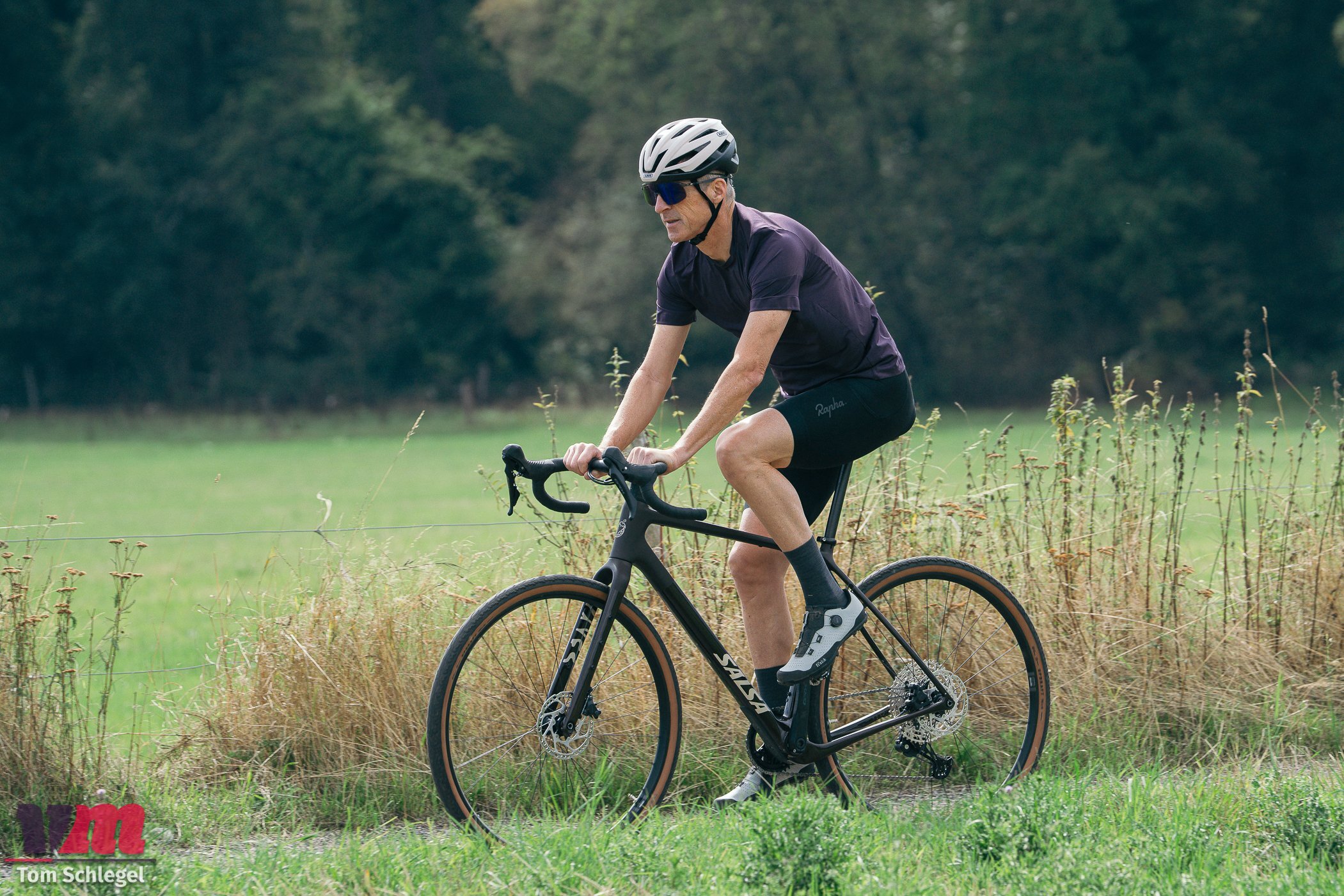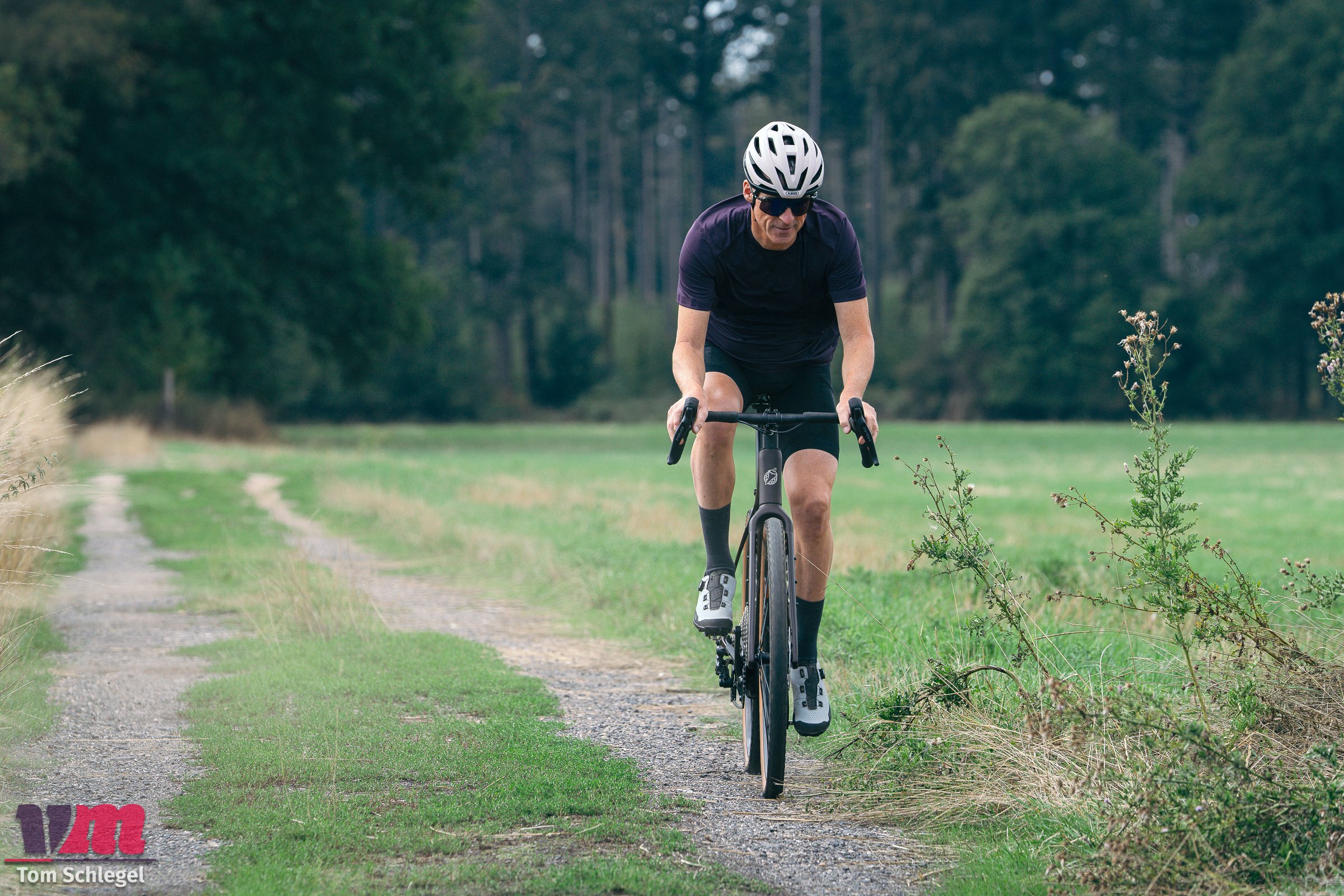
Salsa Flyway review: The new carbon model from the gravel pioneer positions itself as an all-rounder, suitable for everything from sporty riding to multi-day tours. For the latter, it offers various mounting options and ample tire clearance; the former becomes apparent after adjusting the riding position. Above all, however, this sleek bike scores points with its outstanding riding comfort.
Salsa can claim to have brought the very first production gravel bike to market. The Warbird was available in stores from 2012 – a new type of bike designed to be a better solution for fast tours and long races on gravel than the agile cyclocross bike. The Salsa Warbird had a slacker head angle and a longer wheelbase, and it used disc brakes from the outset, while many cyclocross bikes were still using rim brakes. The riding position was also different: for greater comfort on long rides, the rider sat more compactly and upright on the innovative bike, whereas the riding position of modern gravel race bikes is more reminiscent of the classic cyclocross bike.
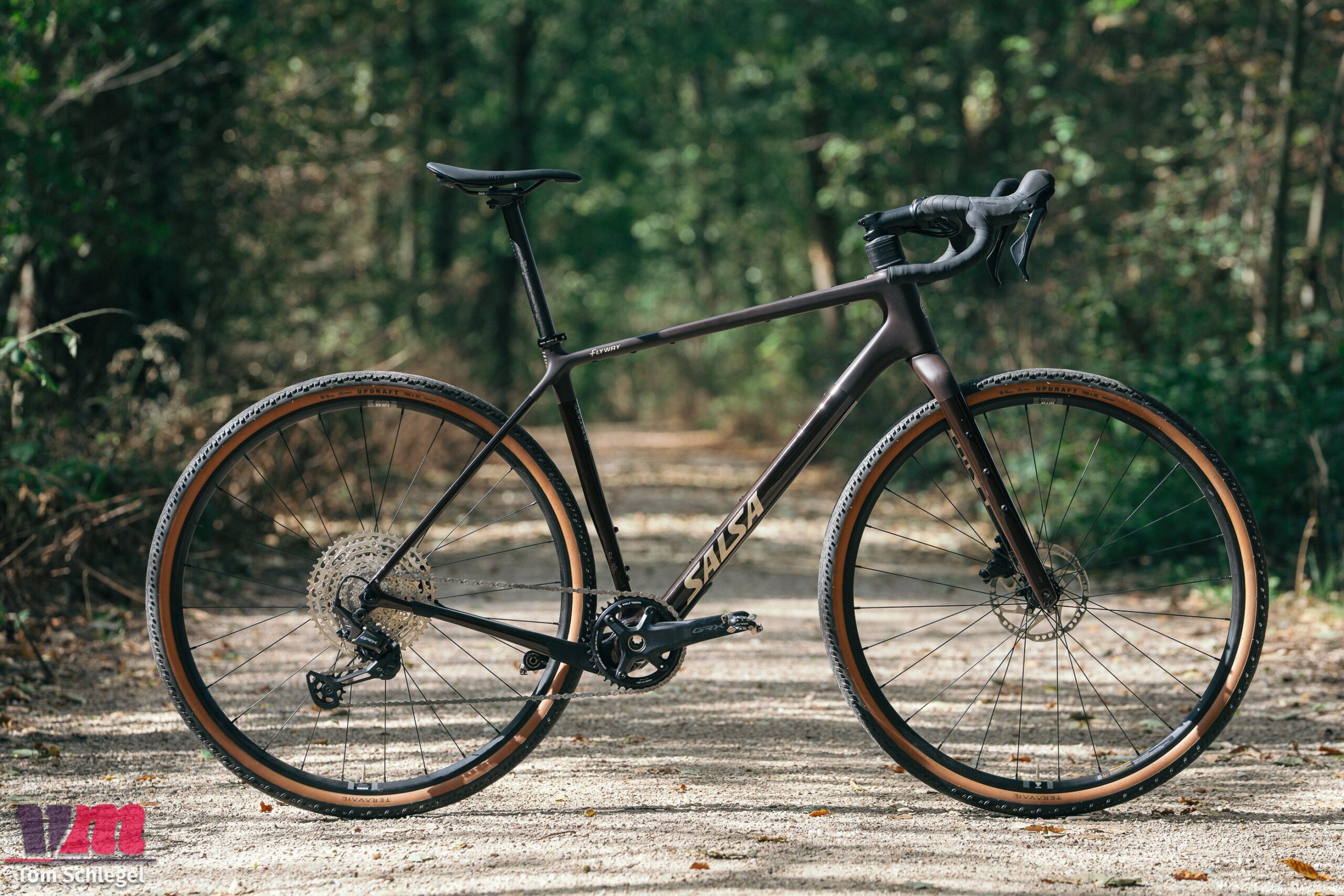
With the new Salsa Flyway, the brand is taking a slightly different direction. While the handlebar height remains similar, the seat length is now a bit longer, though this is partially compensated for by shorter stems. The head tube angle is slightly slacker, the seat tube angle steeper, and the wheelbase longer, even though the Flyway's chainstays are somewhat shorter. Taken together, this results in an all-around geometry suitable for a variety of uses.
Salsa Flyway: the highlights
- Carbon frame with vibration-damping VRS rear suspension
- Versatile geometry for different applications
- Tire clearance 50/57 mm (front/rear)
- Weight 9,98 kg (size M/L, without pedals), front wheel/rear wheel 1.720/2.650 grams
- Price 3.499 Euro
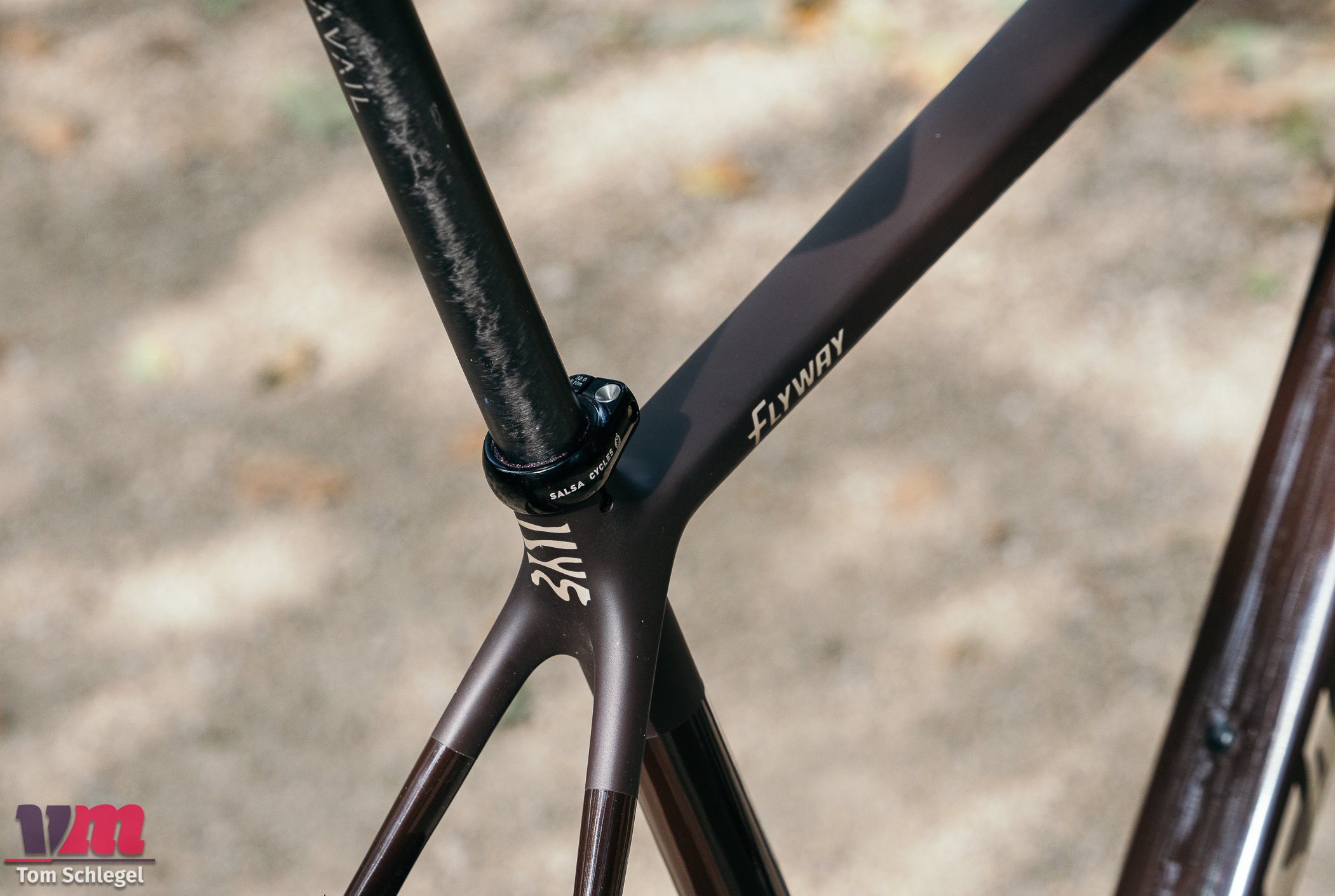
The slim frame eschews aerodynamic shapes, instead focusing on an optimal balance of lateral stiffness and vertical compliance. The top and down tubes are wider than they are tall; the bottom bracket area, with its downward-sloping chainstays, is quite substantial. Added to this are thin, slightly outward-curving seat stays, which serve a specific purpose: they are designed to dampen vibrations and road shocks; the abbreviation VRS likely stands for "Vibration Reduction System." The flattened bottom of the seat tube acts as a flex zone, and because it is quite short, the seatpost is extended far out, allowing it to flex as well.
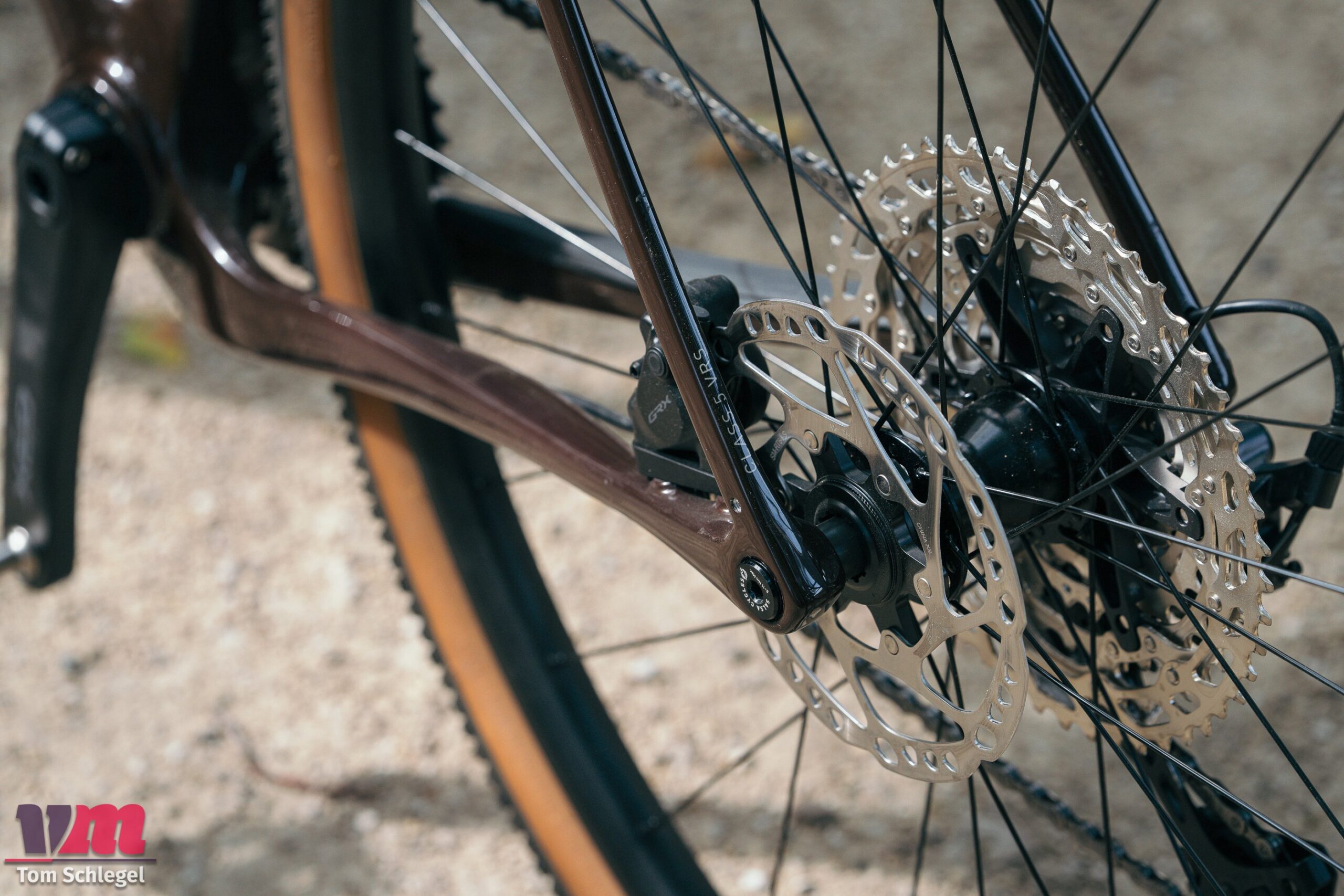
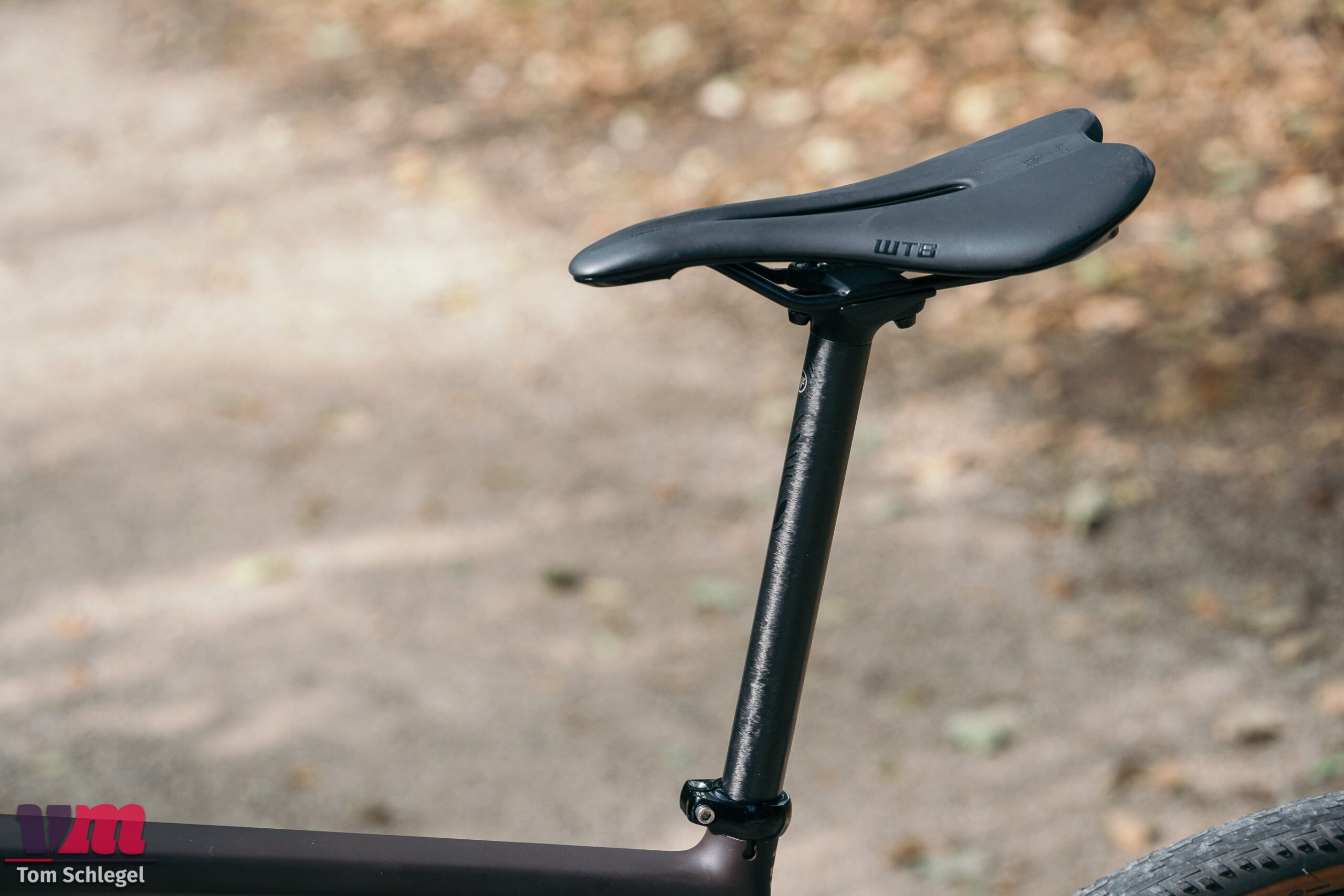
Salsa Flyway: Curved seat stays and flex zone
The Salsa Flyway doesn't have a storage compartment in the downtube, but it does have numerous threaded holes for accessories. For those wanting to mount a rear rack, a special seatpost clamp called "Rack-Lock" is included, to which the rack's horizontal strut can be bolted. The fork accommodates a 57 mm tire, and the rear triangle a 50 mm; touring with luggage is therefore just as feasible as trail riding.
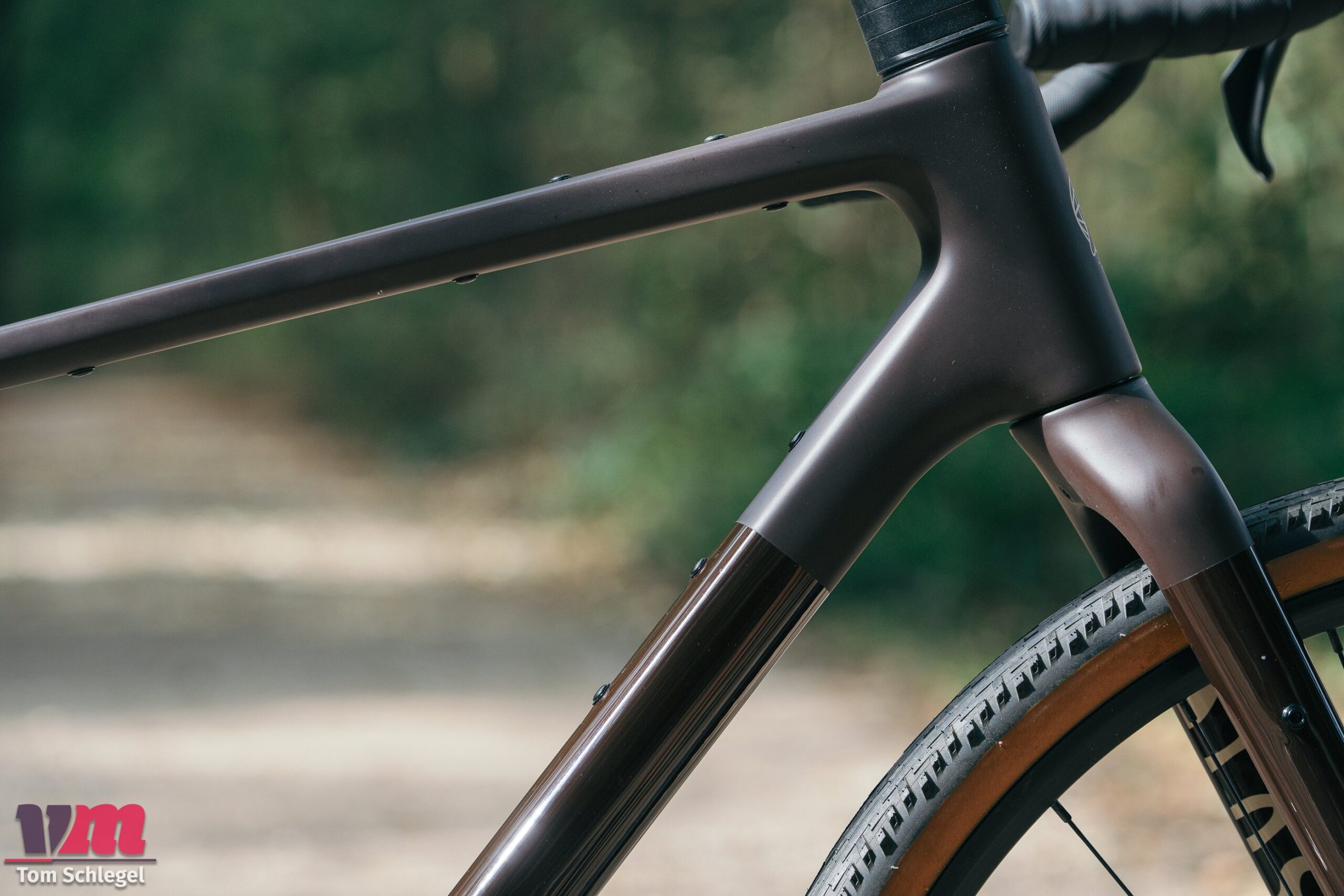
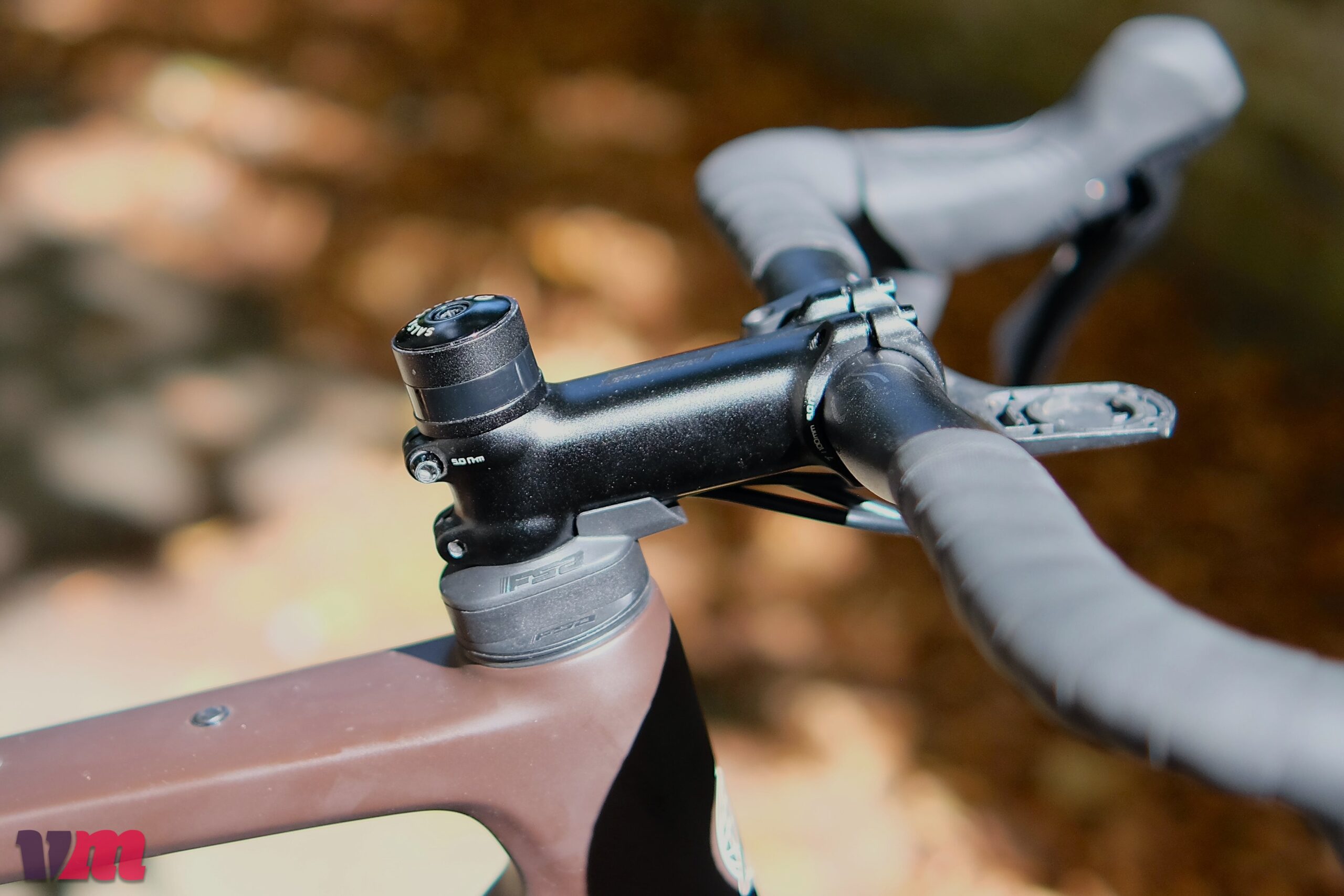
This also demonstrates the versatility of the concept, although the Salsa Flyway still looks the sportiest of the manufacturer's twelve (!) different gravel/drop-bar models. But does it ride that way? The first few kilometers reveal that the test bike in size M/L feels agile to the point of being nervous – no wonder with a 70,5° head angle and an 80 mm stem. With 35 mm of spacers underneath, the riding position is also almost too upright.
| XS | S | M | M/L | L | XL | |
|---|---|---|---|---|---|---|
| Top tube length (mm) | 510 | 535 | 555 | 575 | 600 | 620 |
| Stacks (mm) | 540,5 | 549,9 | 568,8 | 592,3 | 625,3 | 644,2 |
| Reach (mm) | 375,2 | 387,7 | 391,9 | 405,2 | 420,7 | 435,3 |
| Seat tube length (mm) | 390 | 430 | 470 | 505 | 540 | 575 |
| Head tube length (mm) | 90 | 100 | 120 | 145 | 180 | 200 |
| Steering angle | 70,5° | 70,5° | 70,5° | 70,5° | 70,5° | 70,5° |
| Seat Tube Angle | 76° | 75° | 74° | 74° | 74° | 74° |
| Bottom bracket drop (mm) | 76 | 76 | 76 | 76 | 76 | 76 |
| Bottom bracket height (mm) | 283 | 283 | 283 | 283 | 283 | 283 |
| Chainstay Length (mm) | 425 | 425 | 425 | 425 | 425 | 425 |
| Fork length (mm) | 420 | 420 | 420 | 420 | 420 | 420 |
| Fork deflection (mm) | 51 | 51 | 51 | 51 | 51 | 51 |
| Wheelbase (mm) | 1012 | 1027 | 1038 | 1060 | 1087 | 1108 |
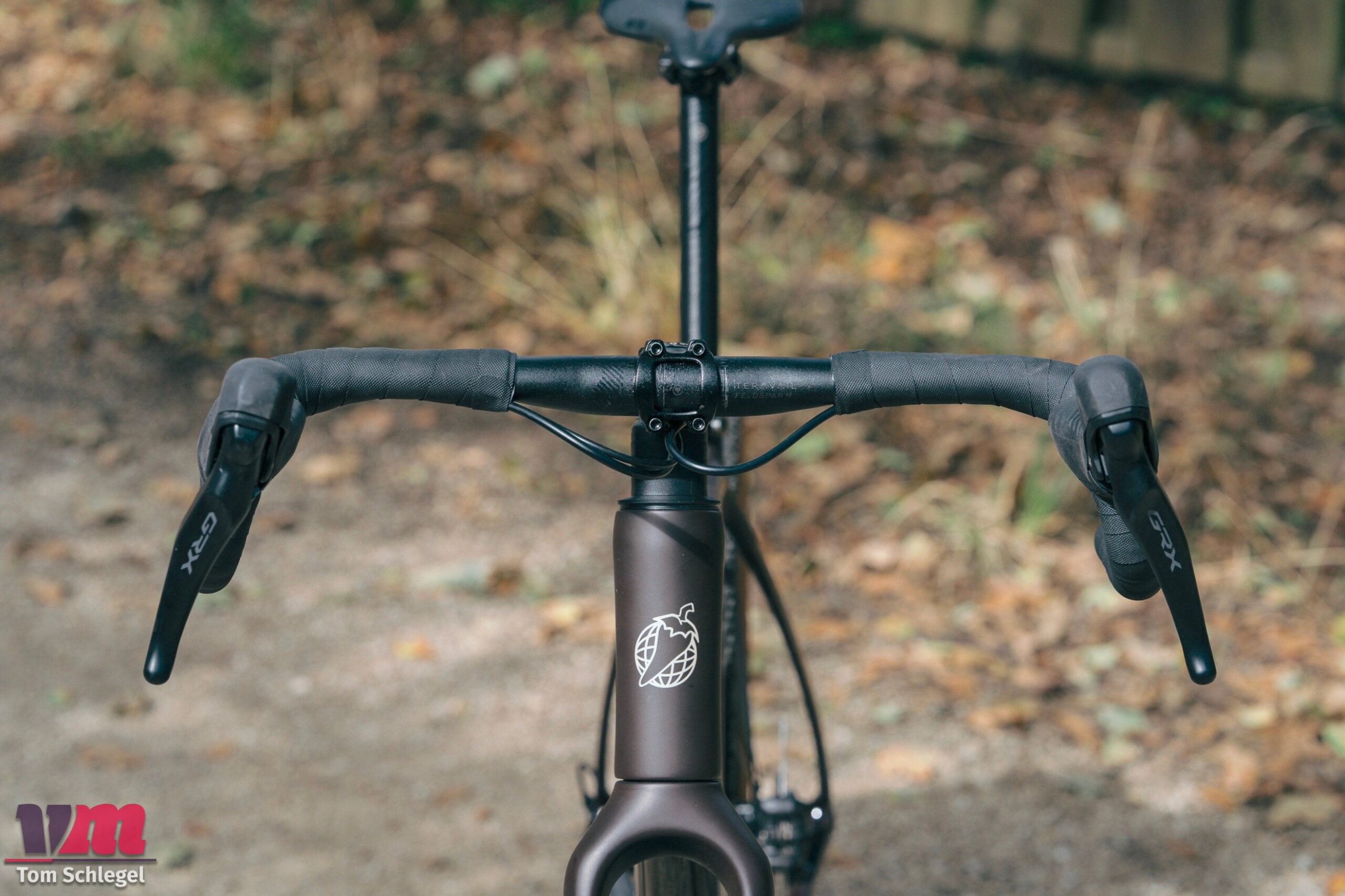
All of this is no problem given the Salsa's overall design. The brand uses a conventional round stem; a grommet guides the brake lines and shift cable into the head tube, ensuring a smooth transition to the split spacers. Removing spacers and installing a different stem is very easy with this system, and after a quick adjustment, the handlebars are 25 mm lower and 2 cm further forward. This results in a noticeably sportier riding position and stabilizes the steering just enough so that the Salsa Flyway still feels very agile, but is more composed and easier to steer.
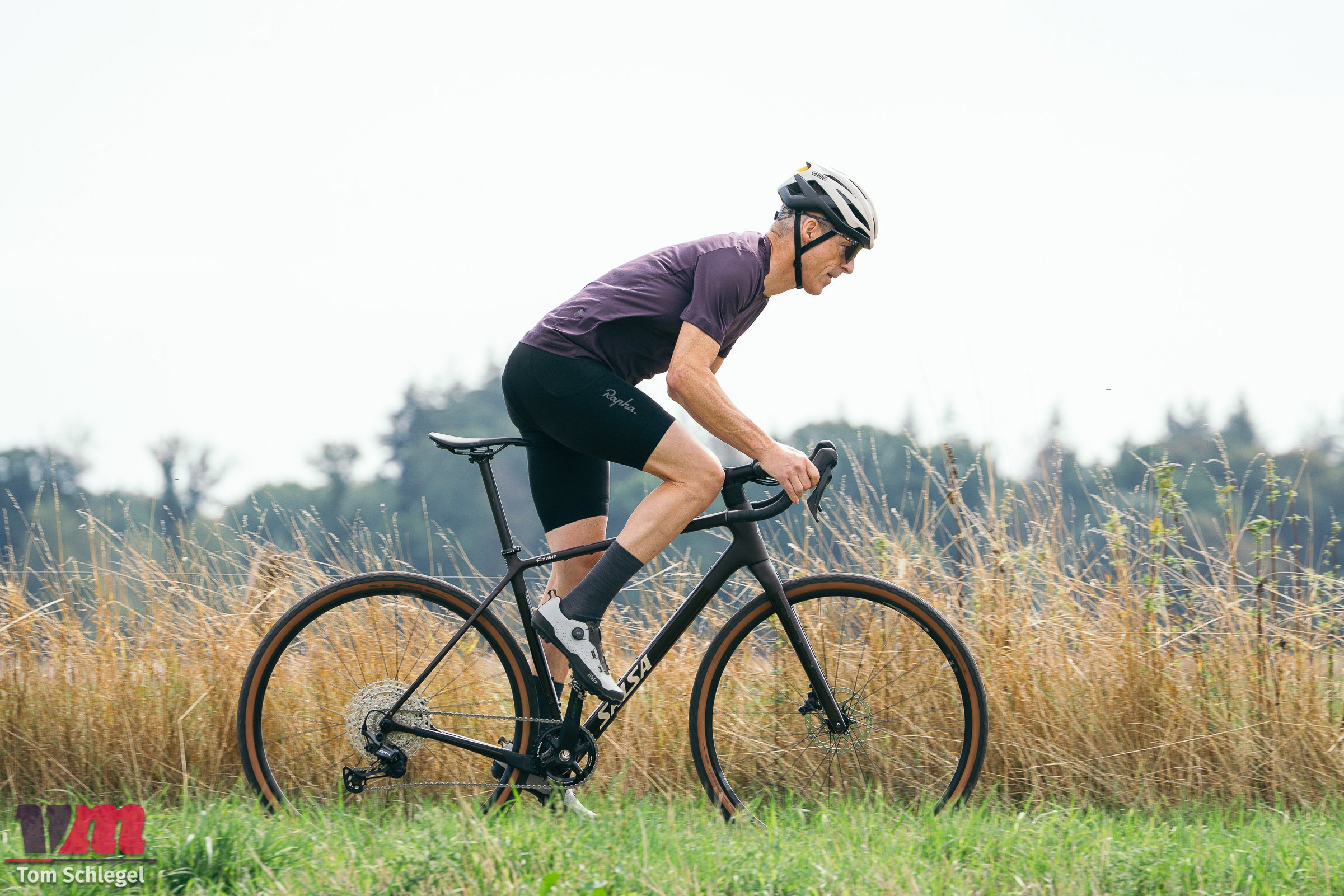
On asphalt as well as off-road, the bike impresses with its stable straight-line tracking regardless of speed – even on steep sections where the speedometer shows just 6 km/h, you can still easily hold your line. On winding trails, the Flyway loses none of its lively feel, even with a 100mm stem – quick changes of direction are no problem; the Salsa inspires confidence on steep descents. The 45mm Teravail tires with their semi-slick tread and arrow-shaped shoulder knobs are a pleasant surprise: at around 2 bar pressure, they provide excellent cornering grip and plenty of traction uphill on loose surfaces.
Semi-slick tires with high cornering grip
The Flyway's most striking feature, however, is its exceptionally high level of damping comfort at the rear. VRS struts and a carbon seatpost absorb vibrations and shocks extremely effectively, smoothing out even rough gravel sections, which also benefits power transfer and traction. Where the rear end of other bikes starts to bounce and makes pedaling difficult, the Salsa practically glides over bumpy surfaces, allowing for optimal power transfer to the pedals. On long rides, this high level of comfort should reduce fatigue and help you stay fresher for longer. Even considering the thin bar tape, the front end feels almost a bit harsh in comparison.
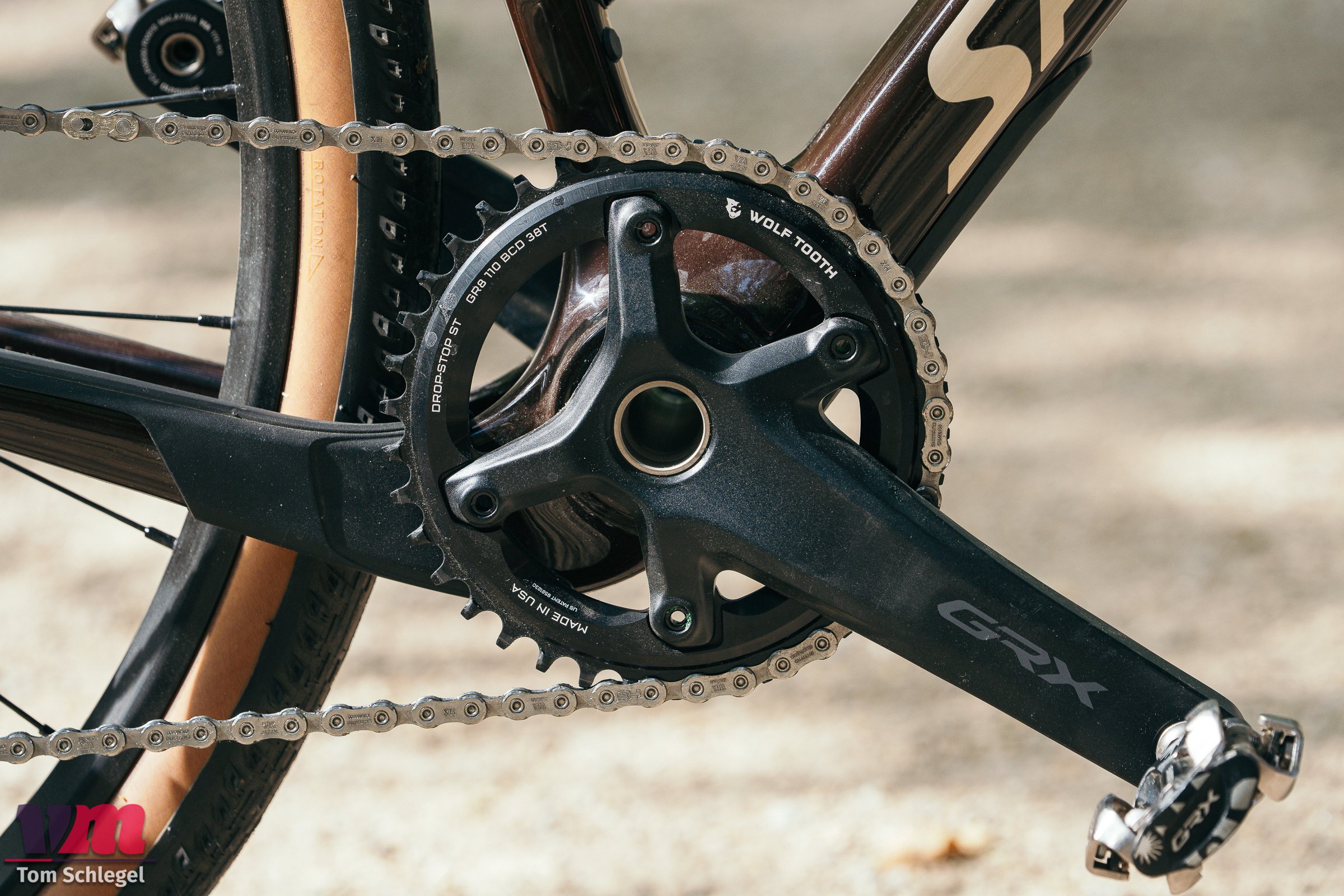
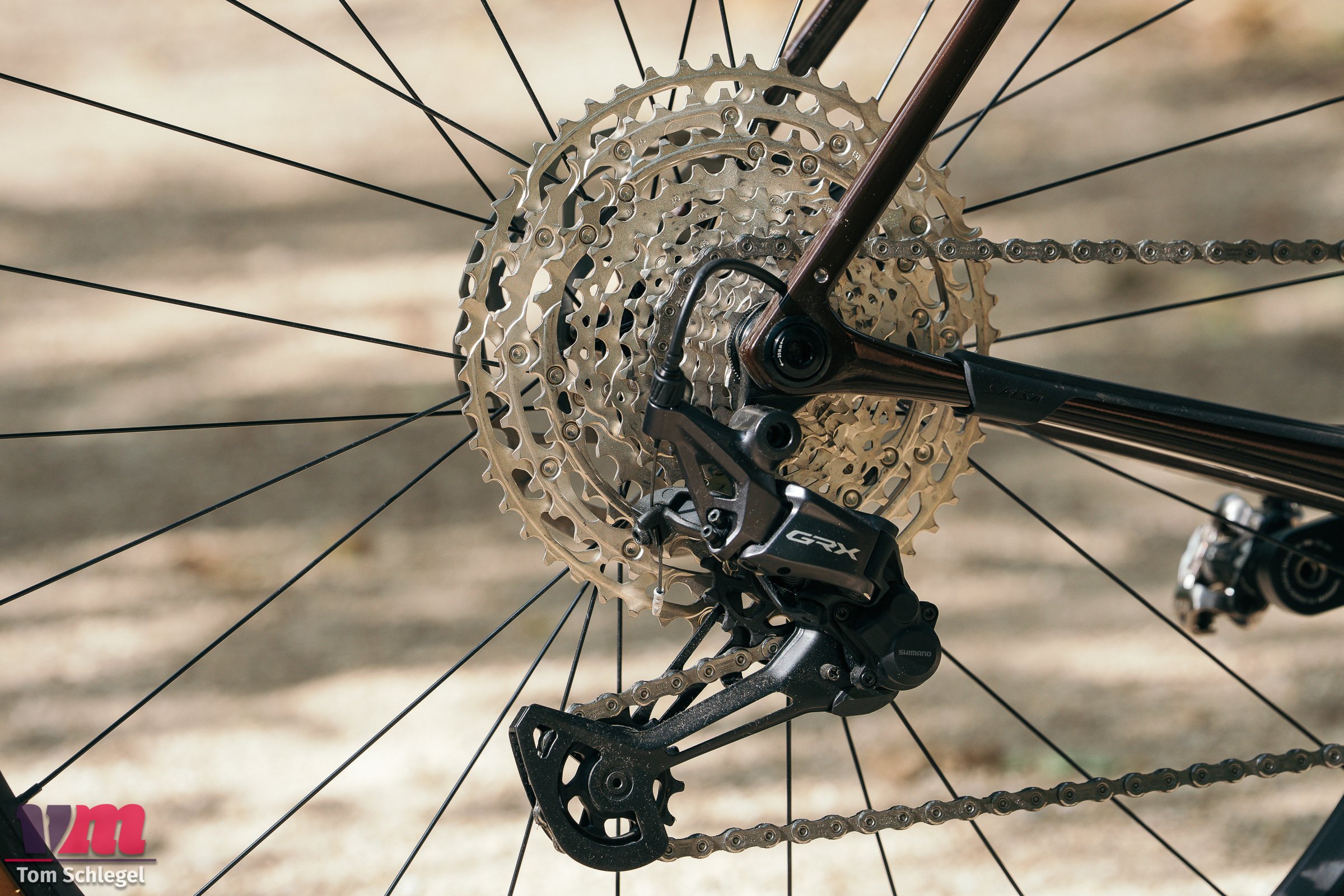
Salsa equips its most affordable Flyway with a Shimano GRX 610 1x12 groupset, which is always a good choice. The 10-51 cassette offers super-easy climbing gears, especially since the test bike is fitted with a 38-tooth chainring from WolfTooth – Shimano itself doesn't offer anything smaller than 40 teeth. However, the two-tooth jumps in the higher gear range aren't ideal depending on the intended use. Salsa is missing a dedicated gravel cassette that could sacrifice the easiest climbing gear in favor of closer-spaced high gears.
Not too easy, nor very cheap.
At just under ten kilograms including pedals, the €3.499 bike isn't exactly light, with the wheelset alone weighing almost 4,4 kilograms – saving a good kilogram here is certainly possible. Other model variants are significantly more expensive; for example, the version with SRAM Apex/Eagle 1x12 costs an extra thousand euros. With a suspension fork, dropper post, and SRAM Rival XPLR, the bike even costs €5.499. A frameset for self-assembly is also available, but only in the slightly lighter "Deluxe Carbon" version for €2.999 In terms of price, the Salsa Flyway is on par with top US brands, and given its excellent ride comfort, it's certainly worth the money. However, it seems somewhat detached from the local market.