


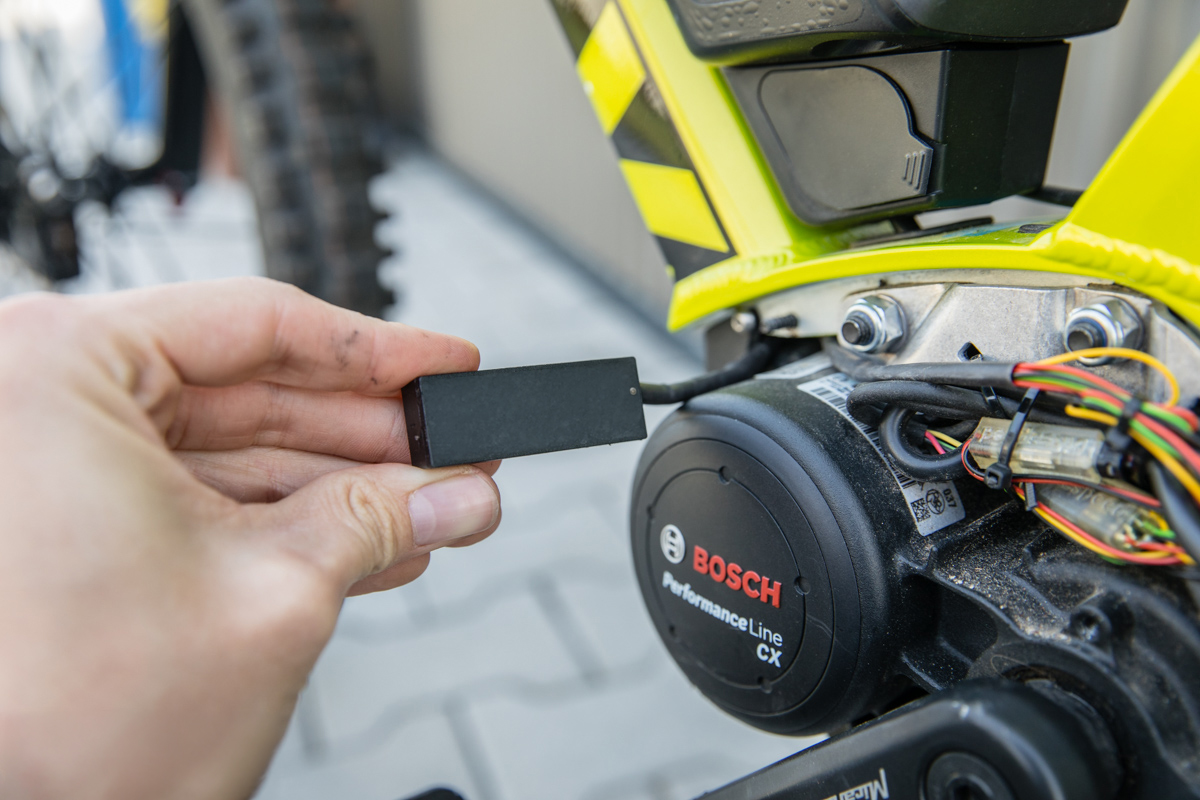
A tuning kit, a dongle, or software manipulation – and suddenly the motor provides assistance even above 25 km/h. What sounds like a relatively harmless but tempting technical trick to some e-bike riders can have far-reaching consequences. Legally, this transforms a standard pedelec into a motor vehicle. The situation becomes particularly dramatic if an accident occurs: in the worst-case scenario, a few extra km/h can turn into a lifelong financial risk. The European bicycle industry therefore intends to take much stricter action against e-bike tuning and illegal vehicles.
The 25 km/h speed limit is certainly debatable. Sporty riders, in particular, are familiar with the situation: on flat terrain, you quickly reach the cutoff speed, the assistance noticeably stops, and the relatively heavy e-bike suddenly demands to be propelled by your own power. It's therefore understandable that some users would like more assistance, especially considering that different rules apply in other countries. In the USA, for example, the cutoff speed is 20 mph – roughly 32 km/h. Many consider this a more sensible limit.
But is it really acceptable to simply override the legally mandated speed limit with a technical solution? Better not: because that doesn't just change the characteristics of the drive system. It likely alters the legal status of the entire vehicle – with consequences that many users are probably completely unaware of.
A bicycle can become a motor vehicle
A classic pedelec with a maximum continuous rated power of 250 watts only provides assistance while the rider is pedaling, and this assistance decreases with increasing speed. It must stop completely at 25 km/h. If a vehicle meets these requirements, it is generally treated legally as a bicycle – although there is a legal gray area or tolerance zone of ten percent – meaning a pedelec may actually provide assistance up to 27,5 km/h. However, if the motor continues to provide assistance beyond this speed, the pedelec can lose its legal status as a bicycle and become a motor vehicle. This then triggers entirely different regulations.
Depending on the technical specifications, a vehicle may require, among other things, an operating permit, a license plate , a corresponding driver's license, and a helmet. Furthermore, using such a vehicle on bike paths is generally no longer permitted without further ado.
Anyone driving a modified vehicle on public roads without meeting the necessary requirements risks more than just a fine. If, for example, the required insurance coverage or driver's license is missing, it could even constitute a criminal offense.
The biggest risk is not the fine.
This is precisely where the discussion about e-bike tuning often falls short, in our view. Of course, checks, penalty points, or fines can be unpleasant. However, the real risk may only arise if an accident occurs.
A standard e-bike is treated like a bicycle in everyday use. Therefore, damages caused by the rider to others can often be covered by private liability insurance. The situation is different with a modified vehicle. If the e-bike is legally classified as a motor vehicle, then appropriate motor vehicle liability insurance is generally required.
The ADAC (German Automobile Club) explicitly points out that private liability insurance generally does not cover accidents involving modified e-bikes. If a rider subsequently has to pay for the damage they caused themselves, this can have devastating consequences in the case of serious personal injury.
E-bike tuning is no longer a fringe topic.
Against this backdrop, a recent initiative by the European cycling industry takes on particular significance. At the industry meeting in Brussels, the European umbrella organization European Cycling Industries (ECI) clearly stated its opposition to e-bike tuning.
The German trade associations ZIV (German Bicycle Industry Association) and Zukunft Fahrrad (Future Bicycle) have signed a corresponding voluntary commitment. At the same time, the industry is calling on the European Union and its member states to take more effective measures against tuning kits and against illegal and non-compliant e-bikes.
The focus is on two points: Firstly, the largely uncontrolled trade in tuning kits is to be restricted. The associations explicitly point to France as a possible model. Secondly, the police, customs, and market authorities are to take more targeted action against illegal vehicles and imports.
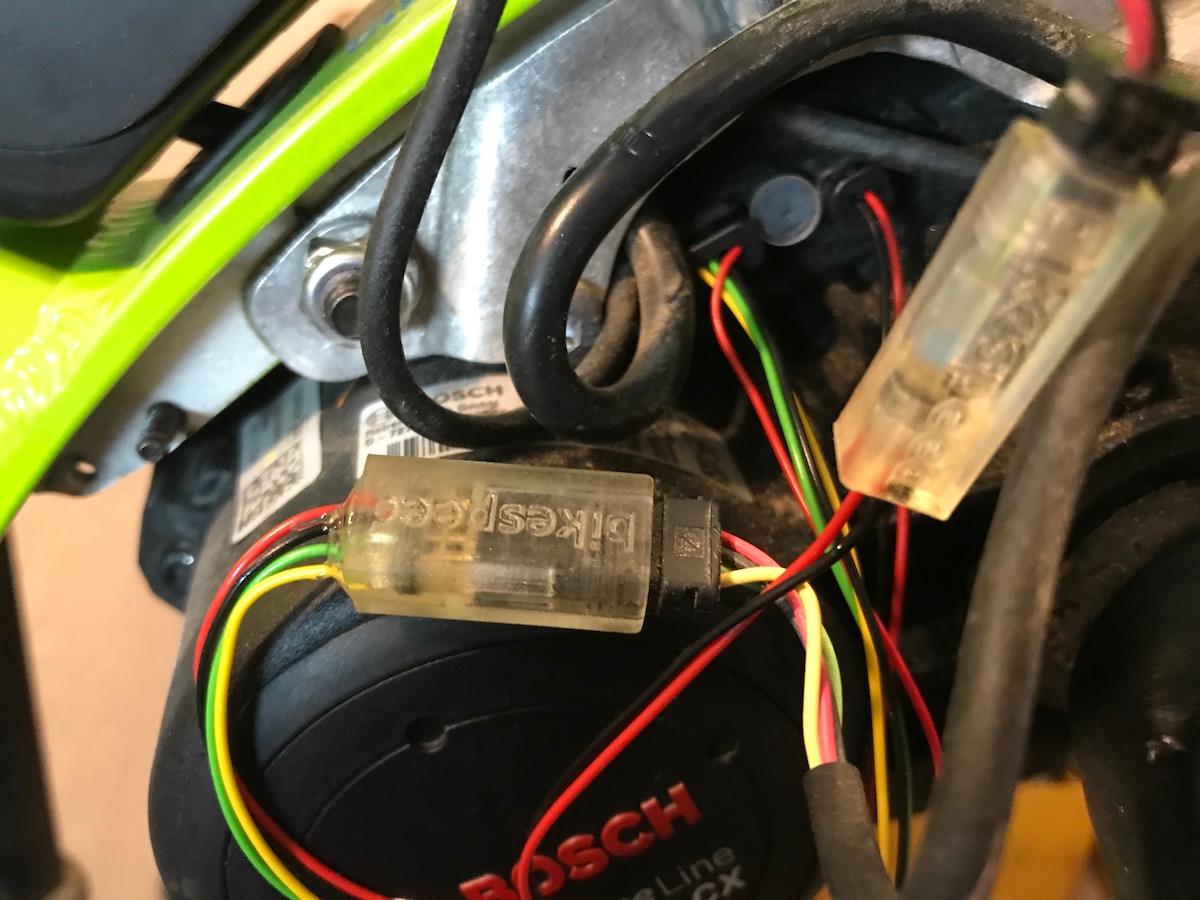
It's not just the classic tuning chip that's a problem.
However, the issue now extends far beyond the classic tuning dongle. The bicycle industry is increasingly observing vehicles that are offered from the factory with performance data that no longer meets the requirements for normal pedelecs.
Products sold through international online marketplaces often reach European customers directly, and it can be difficult to determine whether they actually comply with applicable regulations. For buyers, distinguishing between different types of vehicles isn't always straightforward. A vehicle might look like a regular e-bike but legally belong to a completely different vehicle class.
The problem therefore doesn't only affect deliberate modifications. Even a buyer who orders a supposedly normal e-bike via a platform could, in the worst-case scenario, receive a vehicle that is not legally permitted for use on public roads.
Manufacturers should make manipulation more difficult from a technical standpoint.
With this voluntary commitment, the industry aims to define more precisely what modern technical protection against manipulation should look like. The ECI position paper describes concrete measures that manufacturers should consider when developing drive systems and vehicles.
The aim is not to make every technical modification of a bicycle impossible. Rather, the crucial point is to detect manipulations or to make them so difficult that the legally defined limits of a pedelec cannot be easily circumvented.
This should also make it easier for market surveillance authorities to understand whether a system is actually sufficiently protected against manipulation or only gives that impression.
"This allows a legal EPAC to be distinguished from a tuned or tunable vehicle, which thereby loses its EPAC status and thus its registration."
Even from a technical standpoint, tuning has consequences.
Besides the legal and financial consequences, there is another aspect to consider. An e-bike is a complete system. Frame, brakes, wheels, tires, and drive system are all developed and tested for a specific application.
Of course, a well-made e-bike doesn't suddenly become unsafe just because it's ridden faster than 25 km/h once – after all, such speeds can be reached downhill even without motor assistance. However, consistently higher motor assistance can lead to higher average speeds, different stresses, and increased wear and tear.
Furthermore, tampering with the drive system can significantly complicate warranty, guarantee, or insurance issues. Modern systems can sometimes detect such tampering automatically and may restrict support or store error codes.
17 million e-bikes in Germany alone
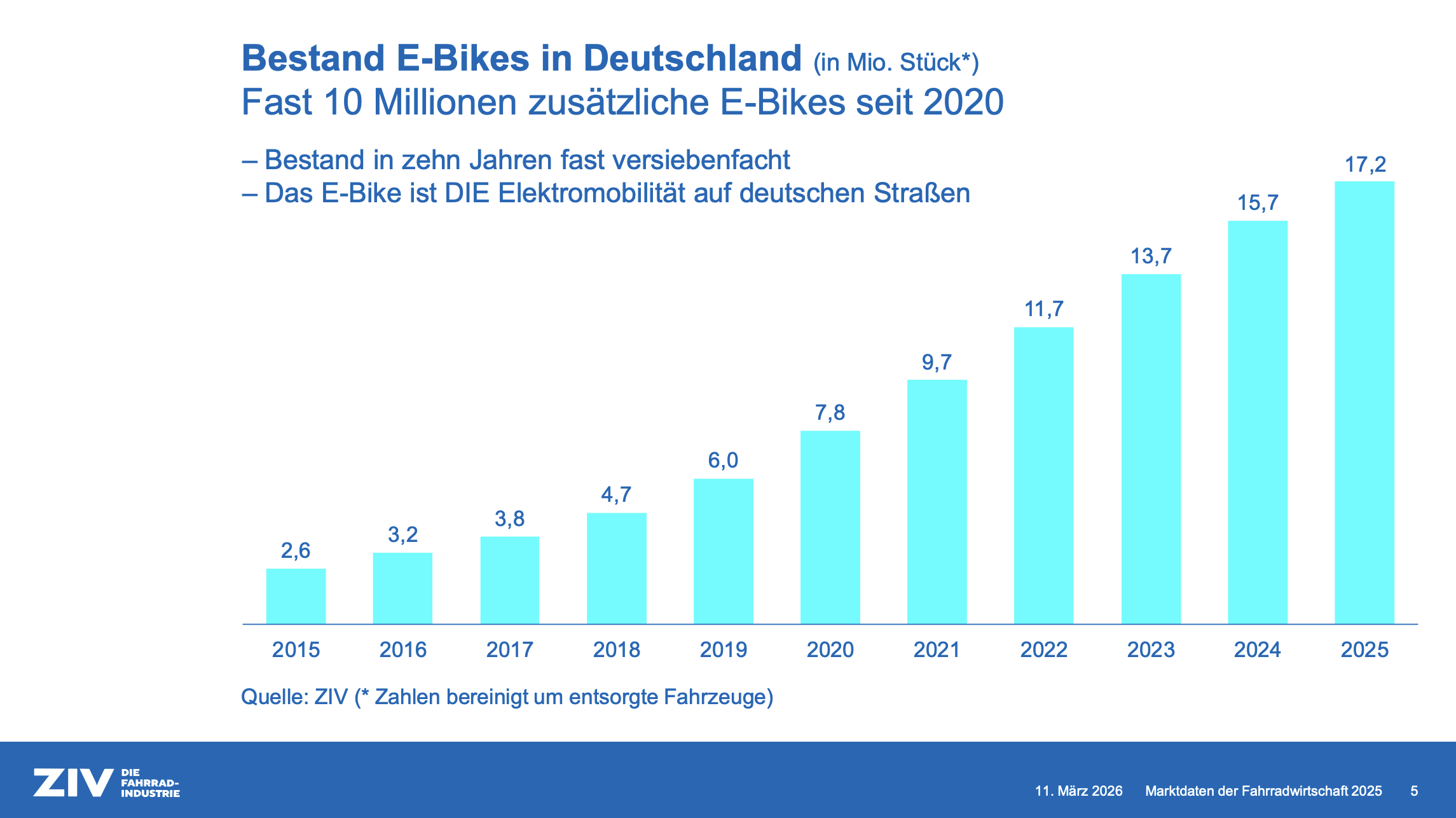
The scale of the issue has become considerable. According to the ZIV (German Bicycle Industry Association), the number of e-bikes in Germany now exceeds 17 million. By 2025, e-bikes will account for more than half of all bicycles sold.
This issue no longer concerns a small technical niche. The larger the number of vehicles becomes, the more important clear rules, functioning market surveillance, and effective protection against manipulation become.
The associations ZIV – the bicycle industry and Zukunft Fahrrad – therefore want to develop an additional German version and a joint package of measures based on the European self-commitment.
Velomotion says: Speeds over 25 km/h are open to discussion – but not the risk.
The legal speed limit of 25 km/h for pedelecs is not a given. It's debatable whether it's still appropriate, whether other regulations would be conceivable, or whether, for example, certain vehicle classes should be treated differently.
However, as long as the legal situation remains as it is, no one should have any illusions about what interfering with the speed limit means.
Anyone who tampers with their e-bike isn't simply making a minor technical modification. In the worst-case scenario, they are then driving an unregistered and inadequately insured motor vehicle on public roads.
The truly worrying thing about this is that the consequences may only become apparent after something has already happened.
A tuning kit might only cost a relatively small amount. A serious accident, on the other hand, can have financial consequences that can affect a person for decades. In our view, a few extra km/h of engine assistance is not a reasonable cost.
Conclusion
The fact that the European bicycle industry is tightening its measures against tuning is therefore more than just industry policy. Technical protection against tampering, stricter controls, and a more consistent approach to illegal imports can help protect riders and other road users.
However, education is at least as important. Many e-bike users are probably unaware that a seemingly minor modification can change not only the speed of their bicycle, but potentially its entire legal classification.
And that's precisely what makes e-bike tuning so risky: the tuning chip itself isn't the big problem. It's the potential consequences if something goes wrong afterwards.