


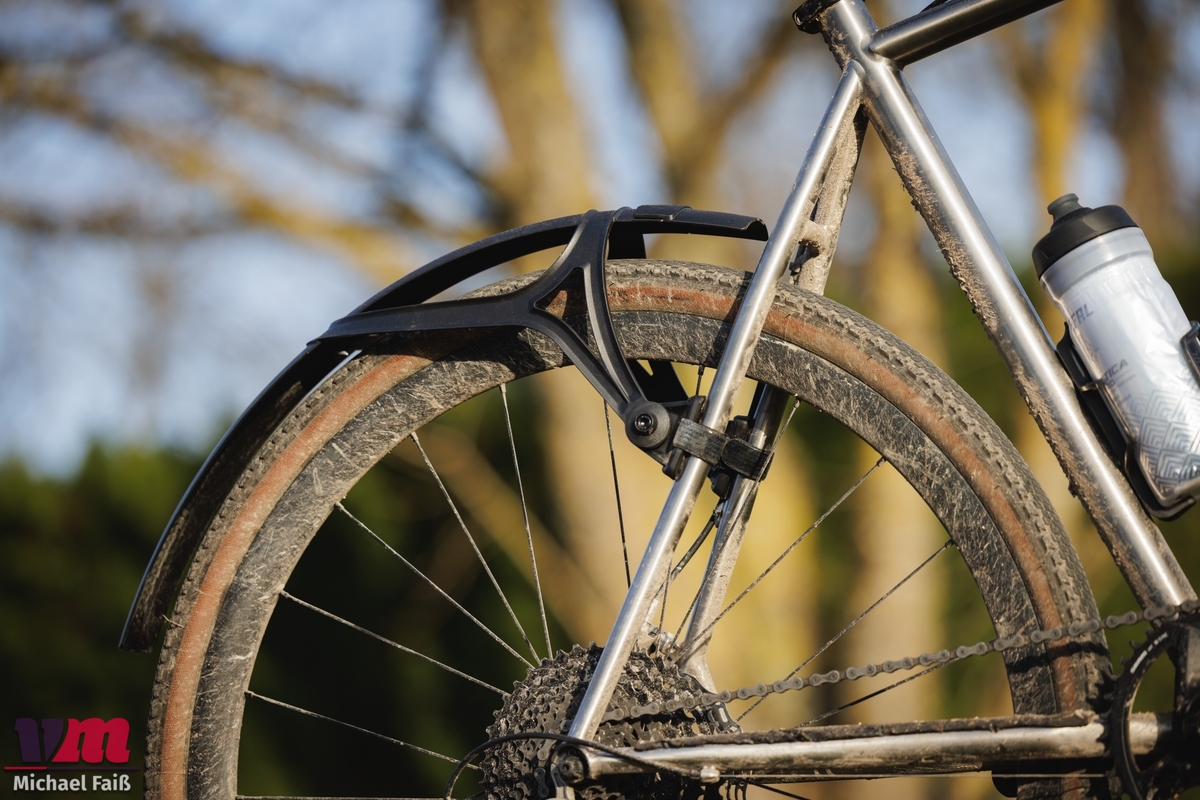
Test / Accessories: Clip-on mudguards are traditionally a compromise: they offer less protection than fixed mudguards, rarely fit securely, and are often cumbersome to install. The Zéfal Shield G50 aims to change that – with a strap-based mounting system that requires no eyelets or stays. We mounted the gravel set on an older gravel bike and rode it for several weeks in wet conditions and off-road.
Why clip-on mudguards are a topic on gravel bikes
Many gravel bikes come equipped with mounts for fixed mudguards, but many others don't – and even where eyelets are present, installation is considered a test of patience. Cutting struts to length, aligning distances, readjusting: anyone who's ever done this knows that an afternoon can easily disappear. Furthermore, fixed mudguards are a permanent solution. Those who only want their bike protected during the wet season will have to switch mudguards twice a year.
Are you interested in a mudguard for retrofitting?
If you want to buy the Zefal Shield G50 – or other accessories – online, please use this link.
By doing so, you support Velomotion; this allows us to continue being free to read.
This will not put you at a disadvantage.
Clip-on mudguards address this gap, but traditionally come with two disadvantages: less coverage and a less stable fit. The latter is particularly relevant in gravel riding, where vibrations and impacts are significantly higher than on asphalt. A mudguard that twists after 20 kilometers of gravel and rubs against the tire is no solution.
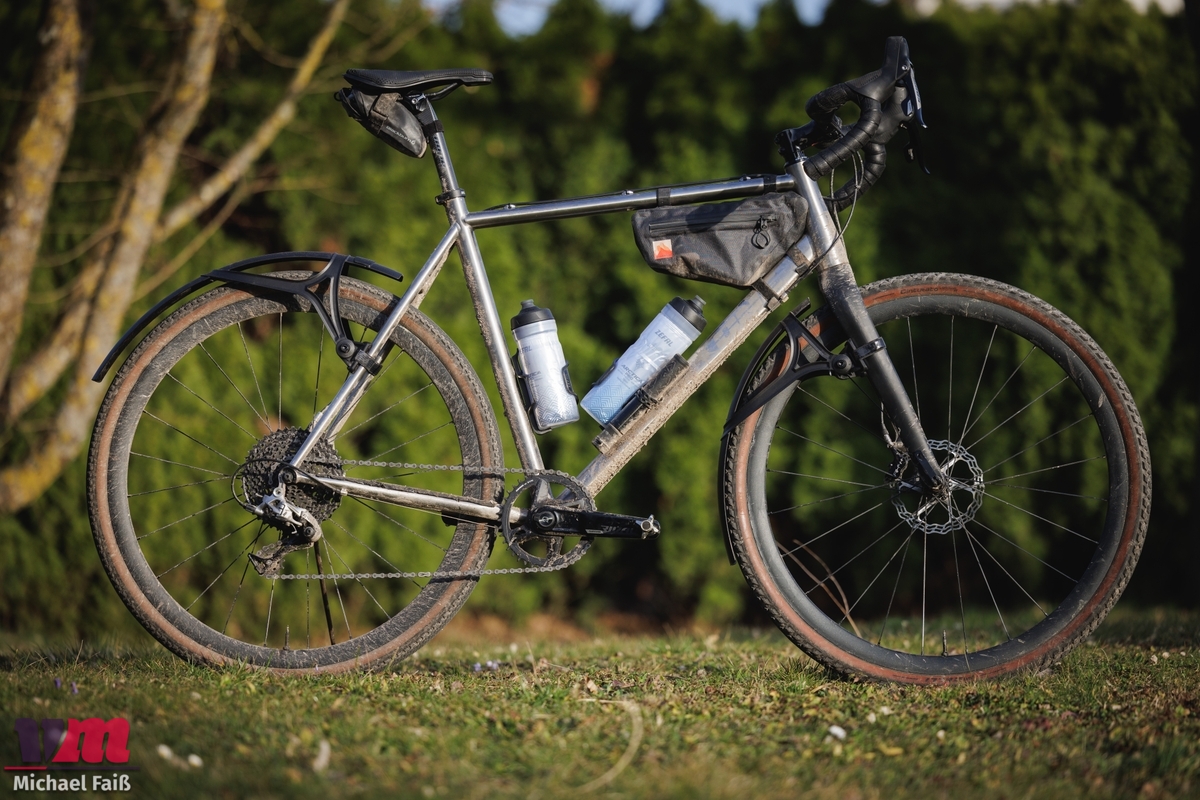
The Shield G50 is Zéfal's answer to this. The French company explicitly positions the set as gravel-specific and advertises a mounting position close to the tire that is both discreet and effective. According to the manufacturer, the set is developed and manufactured in France.
MD-Strap: Attachment to the frame without screws
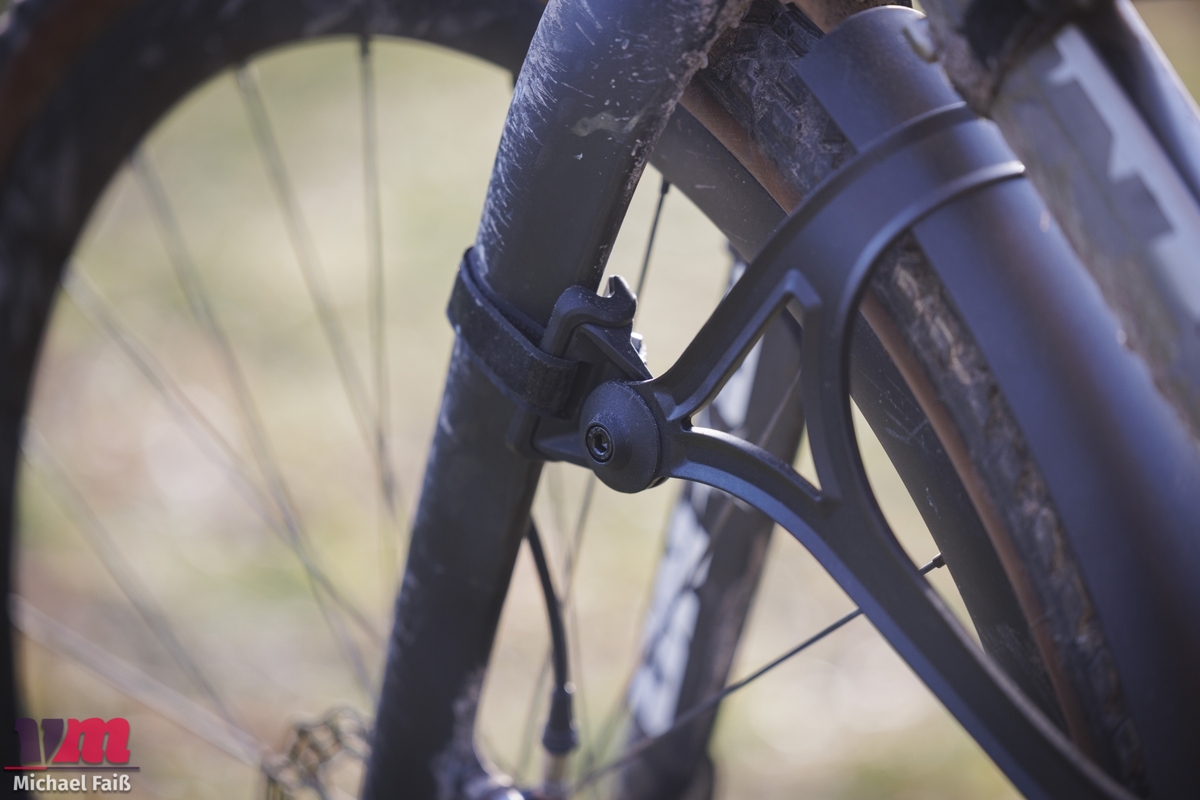
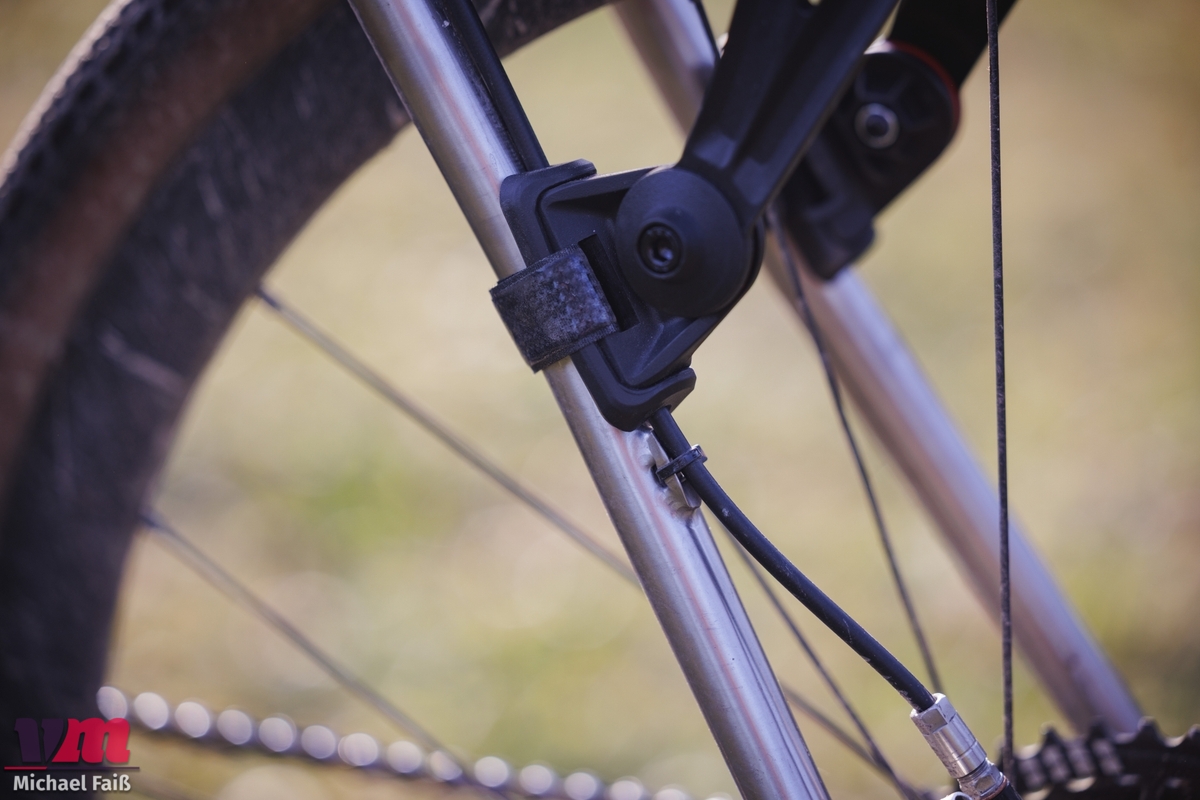
The core of the concept is the mounting system, which Zéfal calls the MD-Strap. Instead of fixed screws, it uses silicone-coated Velcro straps, which, along with soft buffer elements, are wrapped around the fork leg or seat stays. The silicone coating is designed to protect the paintwork – however, Zéfal still recommends a transparent frame protector film for added protection.
The system offers a generous range: at the front, it accommodates diameters from 10 to 55 millimeters, and at the rear, from 10 to 32 millimeters. The straps measure 210 millimeters at the front and 150 millimeters at the rear. This means the G50 covers virtually all common frame and fork designs, including aerodynamically shaped profiles.
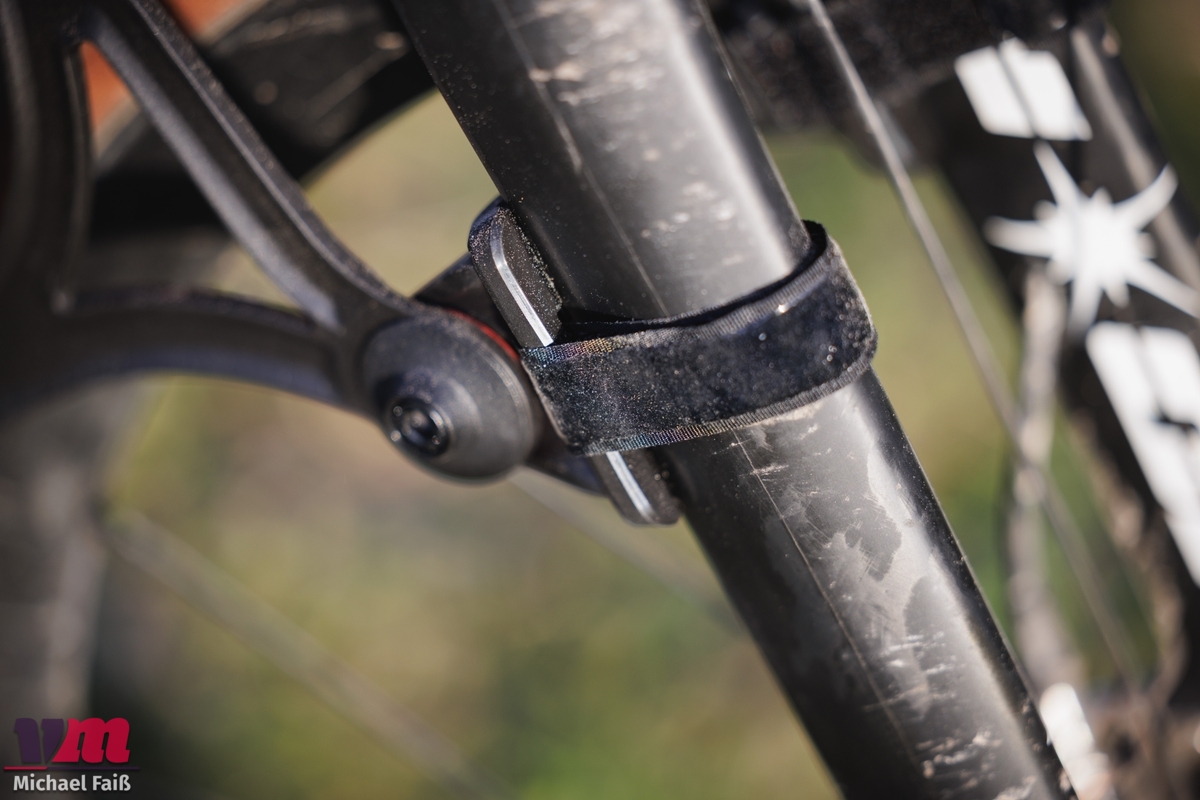
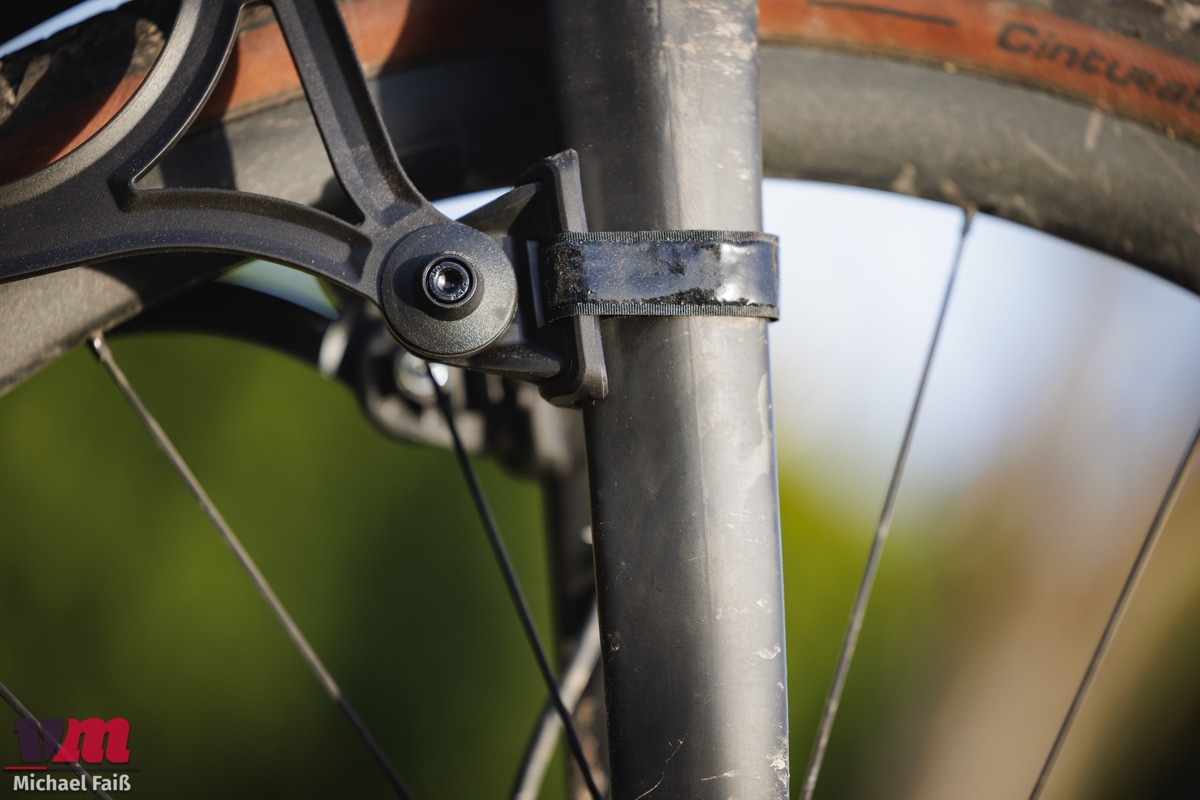
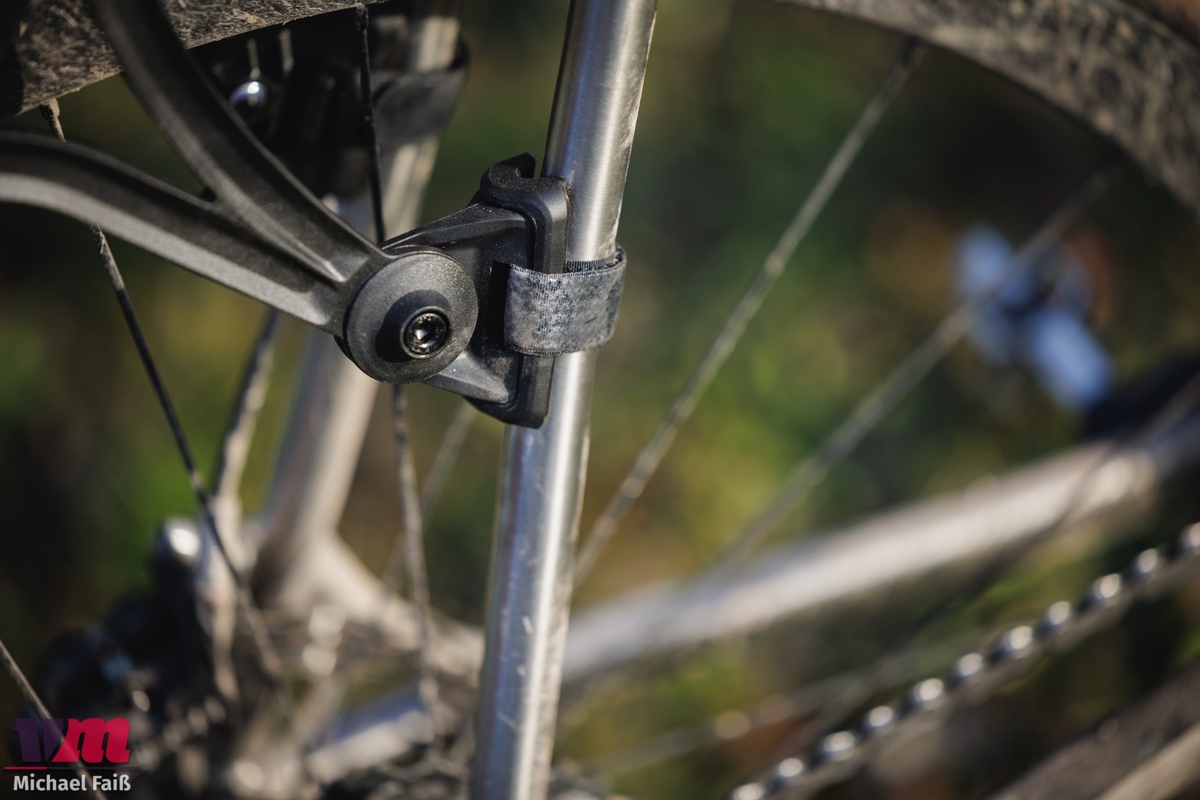
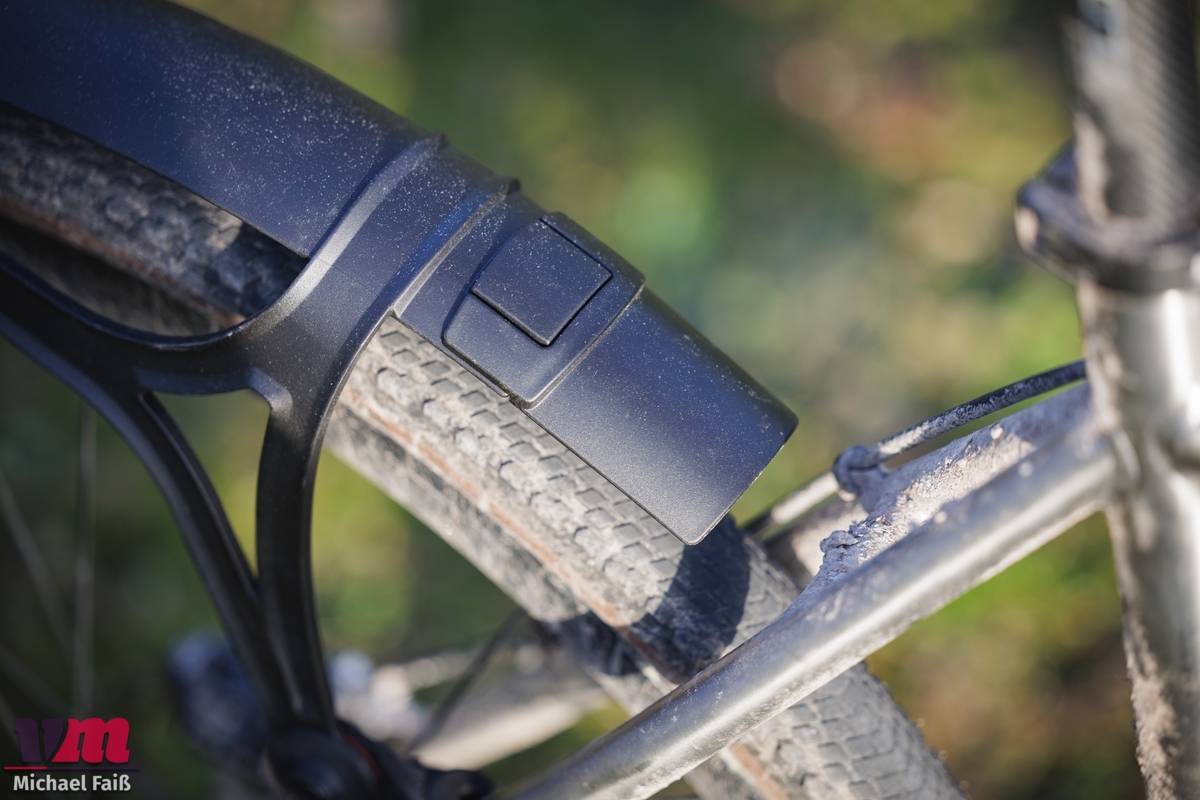
The alignment is two-stage. The tilt angle can be fixed with an Allen key, and three different inserts are available at the rear to adapt the mudguard to the seat stay geometry. In addition, three spoilers in lengths of 20, 60, and 120 millimeters are included to extend the rear mudguard – depending on the available space in the frame geometry.
Technical data and operating limits
The Shield G50 is made of technopolymer, specifically polypropylene with a 20 percent fiberglass content. The front fender measures 461 millimeters in length and 54 millimeters in width, while the rear fender measures 560 millimeters with the 20-millimeter spoiler attached. The front fender weighs 195 grams and the rear 212 grams, for a total of just over 400 grams.
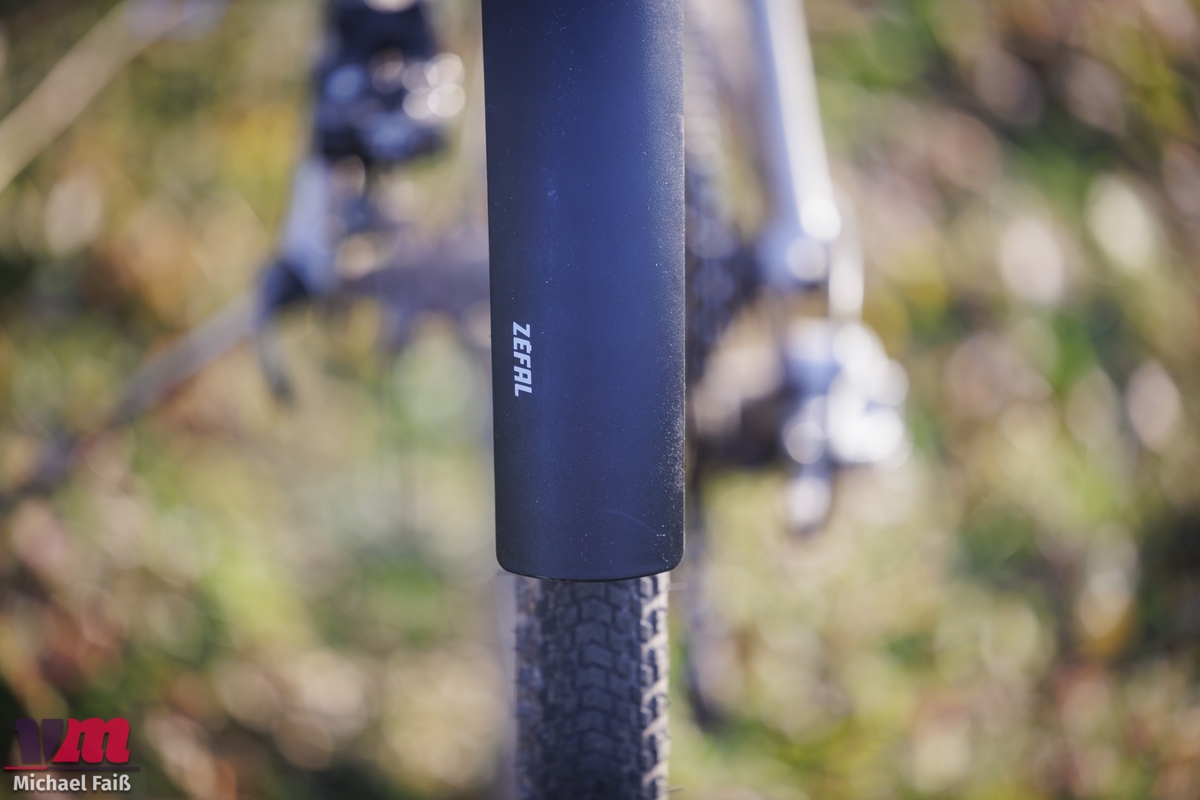
The set is approved for 650B, 28-inch, and 700C wheels. Zéfal specifies a maximum recommended tire width of 48 millimeters – noteworthy because some retailers list 50 millimeters, and the model name suggests this value. When asked, the manufacturer explicitly advises against using 50-millimeter 650B tires in their own support section, as this would result in incomplete tire coverage. Those using wide gravel tires should take this into account.
The set costs just under €45 when sold directly by the manufacturer; it can be found for less in stores, depending on the retailer. This places the G50 in the mid-range of clip-on mudguards.
The sister models: Shield R35 and Deflector M65
The G50 is part of a family that applies the same mounting principle to three areas of use – and this is quite relevant when buying, because the models differ significantly in geometry.
For road bikes, Zéfal offers the Shield R35 . Structurally similar to the G50, it's narrower and designed for tires up to 32 mm wide. Consequently, the weight is also lower: 166 grams for the front and 177 grams for the rear. The set is approved for 650C, 700C, and 28-inch wheels. Otherwise, the same principles apply, including the three spoilers for length adjustment.
At the other end of the spectrum is the Deflector M65 for mountain bikes. Here, Zéfal goes significantly wider: tires up to 2,6 inches (65 millimeters) are approved, as well as wheels from 26 to 29 inches. The mudguards measure 515 millimeters at the front and 710 millimeters at the rear, weigh 260 and 330 grams respectively, and are also height-adjustable – designed for the greater clearance required by a full-suspension bike with the rear end fully compressed. The angle is fixed using a 5-millimeter Allen key, and the manufacturer explicitly points out compatibility with dropper seatposts.
So, if you're undecided between the models, you should focus less on the wheel type and more on the actual tire width. A gravel bike with 2,1-inch tires is better suited to the M65 than the G50.
The Zéfal Shield G50 in practical testing
We mounted the set on an older gravel bike with externally routed cable housing – a scenario that universal mounts don't usually like, because the cables run where the clamp is supposed to be. We then rode for several weeks in wet conditions, on asphalt and on light trails.
First impression: pragmatic rather than high-quality
Upon unpacking, the materials appear to be of average quality. The plastic doesn't feel particularly high-end, and the mounting hardware, including the straps, seems more functional than carefully crafted. This is an observation, not a criticism: given the price, anything else would be surprising, and ultimately, the question is whether the parts work – not how they feel.
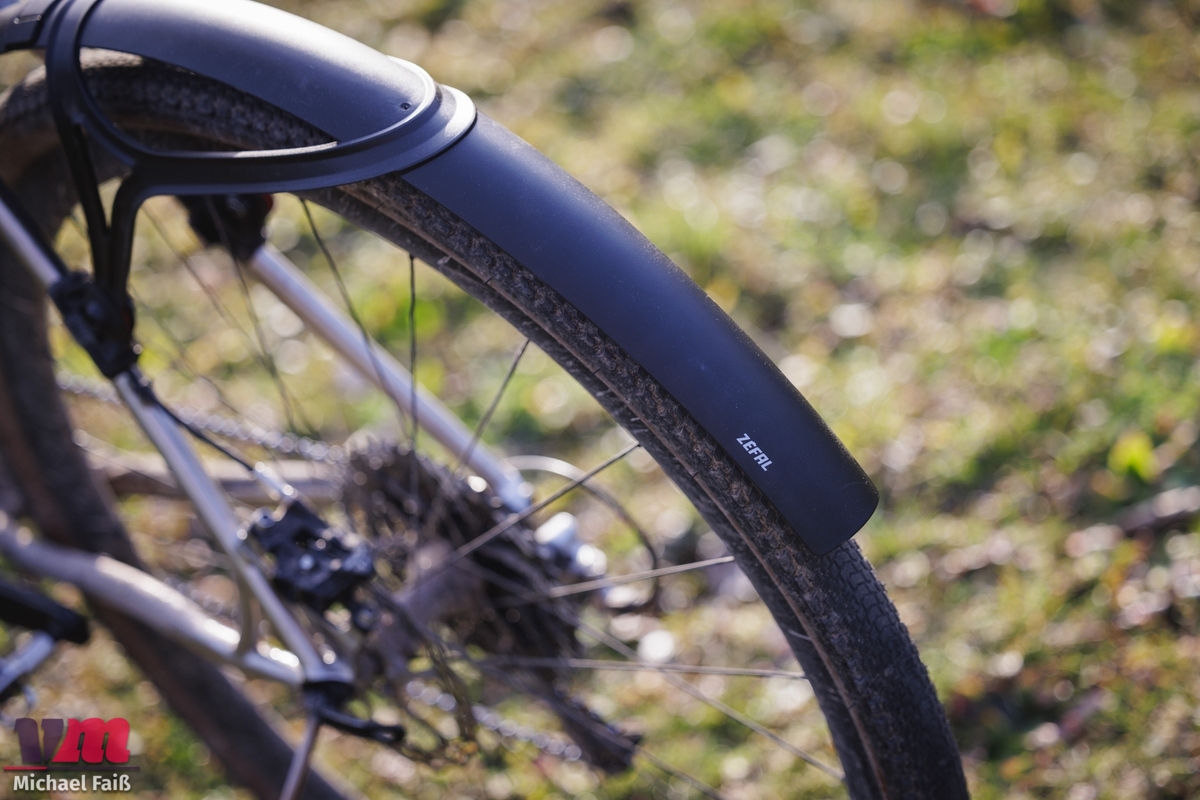
Even after installation, the G50 remains visually unobtrusive. It's not exactly eye-catching, but mudguards rarely are. Its design is significantly slimmer than that of classic full mudguards and doesn't add bulk to the wheel.
Assembly: the real difference
Mounting mudguards is usually a fiddly job. This is especially true for fixed models, but even with clip-on mudguards it often requires millimeter precision. This was different: the installation was exceptionally quick and easy.
The external outer casings on the test bike also posed no problem. The combination of rubber buffers at the contact points and the Velcro straps coped well because the buffers adapted to the existing geometry instead of requiring a flat surface. The tilt angle could then be precisely adjusted using an Allen key, and the three rear inserts for adapting to the frame geometry fulfilled their purpose.
The mistake you shouldn't make
One point deserves special attention because in practice it makes the difference between "working" and "annoying": The Velcro straps really need to be tightened securely. We weren't consistent enough with this at first – with the result that the mudguards kept slipping in wet conditions.
If you pull the straps really tight – and you can definitely apply firm pressure – the metal plates will be rock solid. Zéfal itself points this out in the installation instructions and recommends checking the straps' tightness before every journey. It sounds like standard advice, but in this case, it's meant seriously.
Protective effect and durability in gravel riding
Once correctly installed, there was nothing to complain about. Even during actual gravel riding with off-road sections, the mudguards didn't slip, rattle, or change their angle. This is not a given with clip-on mudguards and is the most important finding of this test.
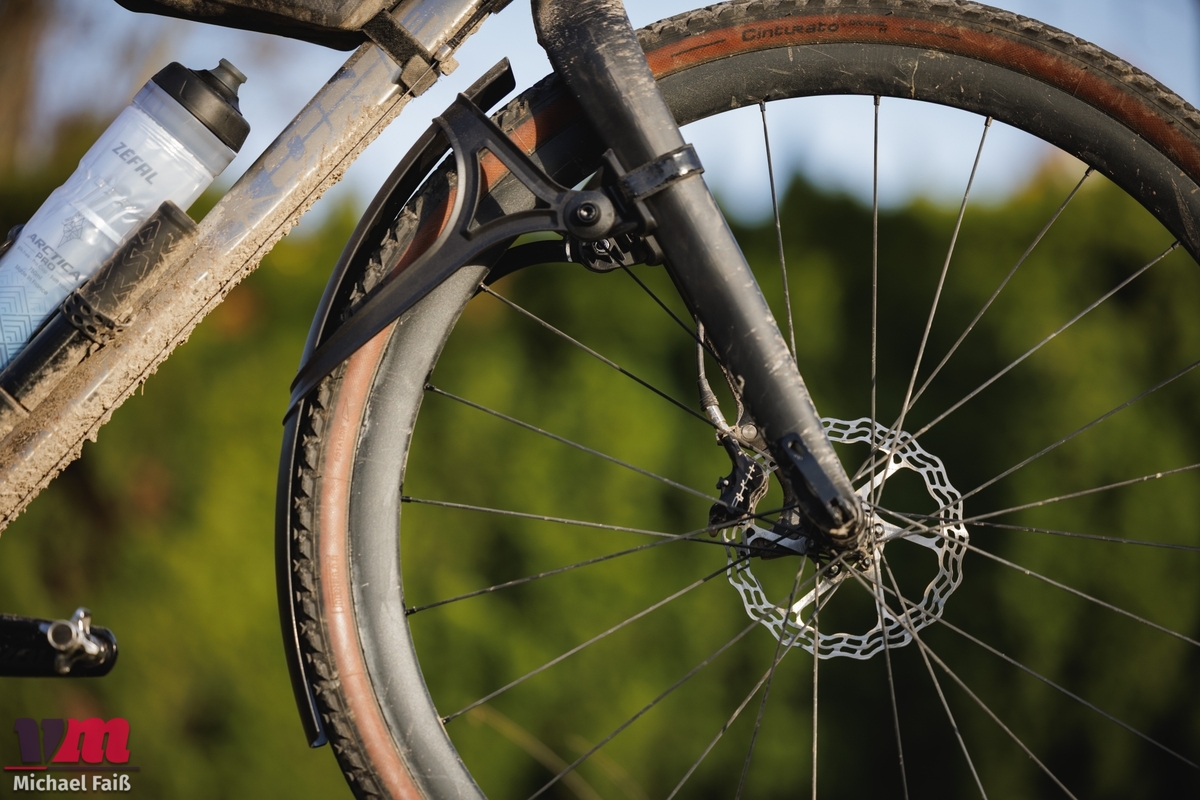
The protective effect itself is good: legs and buttocks stay dry. It's important to understand that the G50 doesn't replace a full mudguard – the coverage is less, and the front wheel isn't shielded all the way down to the bottom bracket. However, it's sufficient for the intended use.
Assembly and disassembly: the underestimated strength
Because it's so quick to install, the G50 becomes a mudguard that you can actually use seasonally or for specific occasions. You wouldn't want to attach and detach it daily – it's just too cumbersome, and it remains to be seen how many cycles the Velcro fastener will withstand in the long run. But for a two- or three-week spell of bad weather, a road trip, or a cycling holiday, the effort is perfectly acceptable.
This is precisely where the practical advantage lies compared to fixed mudguards: you don't have to make a permanent decision.
Are you interested in a mudguard for retrofitting?
If you want to buy the Zefal Shield G50 – or other accessories – online, please use this link.
By doing so, you support Velomotion; this allows us to continue being free to read.
This will not put you at a disadvantage.

